0 products · 0 deals
Filters
No products match your filters.
Prices are fetched automatically and may not reflect current merchant prices. Currency conversions and tax treatment are approximate. Rankings are based solely on price. We are not a dealer and accept no responsibility for transactions with listed merchants. Past performance is not indicative of future results. This site does not provide investment advice. Full disclaimer
About the Argor-Heraeus Classic Platinum
Argor-Heraeus Classic Platinum Bars
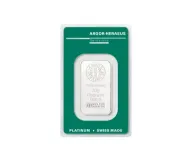
The platinum arm of the Argor-Heraeus Classic range covers minted ingots from 1 g to 100 g, all struck at 999.5 fineness by the Swiss refinery in Mendrisio, Ticino. Where the refinery's gold Classic line splits between cast and minted production, every platinum Classic format is a minted ingot: pressed, serialised, and certified by an Argor-Heraeus sworn assayer, with minted bars shipping in a numbered tamper-evident assay card.
Platinum is a harder sell than gold for most stackers, and the format reflects that. Small minted bars dominate the line because platinum buyers typically commit smaller sums per purchase, and the 1 g, 5 g, 10 g, and 20 g sizes give a low entry point into a metal whose platinum bullion market offers far fewer product choices than gold or silver. The 100 g bar serves buyers building a larger position in one piece.
The refiner's standing matters more in platinum than in gold precisely because the market is thinner. Argor-Heraeus is listed with the LPPM, the London Platinum and Palladium Market, alongside its LBMA credentials for gold and silver and its accreditations with COMEX, TOCOM, and the DMCC. A serialised bar from an LPPM-listed Swiss refiner is about as recognisable as small platinum gets, which supports resale in a metal where dealers scrutinise unfamiliar products more closely. As with the rest of the Classic line, the design is deliberately plain so that the premium pays for metal and certification rather than artwork.
Classic Platinum Bar Sizes
All Classic platinum bars are minted ingots at 999.5 fineness, the standard investment grade for platinum, with no face value and no legal tender status. Each bar is individually serialised.
| Weight | Troy oz equivalent | Purity | Format |
|---|---|---|---|
| 1 g | 0.032 oz | 999.5 | Minted |
| 5 g | 0.161 oz | 999.5 | Minted |
| 10 g | 0.321 oz | 999.5 | Minted |
| 20 g | 0.643 oz | 999.5 | Minted |
| 100 g | 3.215 oz | 999.5 | Minted |
The wider catalogue also includes 50 g, 500 g, and 1 kg platinum sizes beyond those listed on this site. Confirmed dimensions exist for the 5 g bar: 23.0 mm × 14.0 mm × 0.9 mm with a smooth edge. The obverse layout matches the rest of the Classic family: the AH monogram within a double circle, "Argor-Heraeus SA" around the ring and "Switzerland" below, then weight, metal, and fineness stacked vertically with the serial number and assayer mark. The reverse is blank or carries a simplified repeating logo pattern on some platinum bars, in contrast to the fully blank reverse of the minted gold bars. The same Classic line extends to palladium at 999.5 in 1 g, 100 g, and 1 kg sizes, though those are not part of this site's catalogue.
Tax Treatment of Classic Platinum Bars
Platinum gets none of the sales tax shelter that investment gold enjoys in Europe, which is the single biggest cost difference between this page and the gold Classic range.
- United Kingdom: 20% VAT on new platinum bullion. VAT may be deferred under specific storage arrangements, such as bonded vaulting in Zurich or a Delaware free zone, where the metal stays outside the UK. The bars are not legal tender, so disposals are also subject to Capital Gains Tax above the £3,000 annual allowance.
- European Union: Platinum is generally subject to full local VAT, ranging from 17% to 27% by member state; the Investment Gold Directive does not extend to platinum.
- Switzerland: 8.1% VAT on platinum, the lowest rate in Europe.
- United States: No federal sales tax; state rules vary. IRS rules require 99.95% purity for platinum in a precious metals IRA, and at 999.5 the Classic bars meet that threshold exactly, making them IRA-eligible.
- Canada: 0% GST/HST, since platinum refined to at least 99.5% purity in bar form is exempt.
- Australia: GST-free as investment-grade platinum, which requires 99% minimum purity.
- New Zealand: GST-exempt; the platinum threshold is 99% purity, comfortably cleared.
- Singapore and Hong Kong: Singapore exempts platinum of 99% or better purity under its Investment Precious Metals scheme; Hong Kong has no sales tax or import duty on bullion.
The Platinum Line of a Four-Metal Refinery
Argor-Heraeus refines all four investment metals, and the Classic platinum bars are the platinum expression of the same foundational product line that began with the company's gold output in the 1950s. The refinery's platinum and palladium credentials are the youngest of its accreditations: LPPM listing came in 2009, nearly half a century after the company joined the London Gold Market in 1961 and well after silver Good Delivery in 1992.
The corporate machinery behind the bars was built around gold. Argor SA started in 1951 as the first precious metals foundry in Ticino, spent decades under UBS ownership, took its current name through the 1986 joint venture with Heraeus of Hanau, and moved into the purpose-built Mendrisio refinery in 1988, the facility where the platinum line is produced today. Heraeus, itself a German industrial and precious metals conglomerate, completed full ownership in 2017 and folded the company into Heraeus Precious Metals. Beyond bullion, the refinery serves the watchmaking, jewellery, electronics, and chemical sectors, industries where platinum-group metals are working materials rather than investments.
The platinum bars inherit the conventions established by the gold line: individual serial numbers, certification by a sworn assayer, the year-of-manufacture stamp applied to all bars from 1988 onwards, and the minimal obverse-only design. Palladium joined the Classic family on the same 999.5 standard, so the four-metal range shares a single visual identity, with only the metal stamp and fineness distinguishing a platinum Classic from its gold, silver, or palladium siblings.
Classic Platinum vs the Gold Line and Platinum Coins
Compared with the refinery's own gold Classic bars, the platinum line is narrower and structurally more expensive to own in Europe. The gold bars run from 1 g to 400 oz across cast and minted formats and buy VAT-free in the UK and EU; the platinum bars are minted only, top out at 1 kg, and carry 20% UK VAT unless held in bonded storage. Fineness differs by convention rather than quality: 999.5 is the standard investment grade for platinum, where the gold line is struck at 999.9.
Against platinum coins from sovereign mints, the bars trade legal tender status for cost structure. A UK legal tender platinum coin is CGT-exempt for British taxpayers; the Classic bar is not, and gains above the annual allowance are taxable. The bar's counterarguments are the ones that apply across the bar-versus-coin divide: simpler production, serialised assay certification in sealed packaging, and a maker whose LPPM listing gives the product direct standing in the professional platinum market.
Within the small-bar platinum market itself, the Classic competes mainly on refiner recognition. The Ticino cluster gives buyers several Swiss alternatives of equivalent standing, and specifications at these weights are close to interchangeable, so dealer pricing on the day usually decides the purchase. What the Classic specifically offers is the combination of a 999.5 strike that exactly meets the US IRA threshold of 99.95%, five entry sizes from 1 g upwards, and the same authentication regime, serial number, sworn assayer, and tamper-evident card, that the refinery applies to its gold.
Argor-Heraeus Classic Platinum: frequently asked questions
-
Prices track closely with the live $1,671.00 spot price, plus a small fabrication premium that varies by weight and format. We track 5 Classic listings from 1 dealer, spanning gold, silver, and platinum in weights from 1g to 1 kg and beyond. Comparing dealers on this page will show the current best available price.
-
Classic is the core investment bar range from Argor-Heraeus, a Swiss refinery founded in 1951 and based in Mendrisio, Ticino. The line covers gold, silver, and platinum in both cast and minted formats, with a deliberately plain finish: no decorative motifs, just the refiner's hallmark, weight, purity, and a serial number certified by an Argor-Heraeus sworn assayer. It predates the Kinebar and all later specialty lines.
-
Gold Classic bars are 999.9 fine (24 carat). Silver Classic bars are stamped 999.0, Argor-Heraeus's longstanding house notation. Platinum Classic bars are 999.5 fine. All three purities meet or exceed the relevant LBMA Good Delivery standards, and the gold and silver bars carry full LBMA Good Delivery accreditation.
-
Generally yes. Cast bars in the Classic range carry the lowest premiums, as their plain finish minimises production cost. Minted Classic bars sit just above cast in premium. Argor-Heraeus does not produce Classic coins in the traditional sense (these are bars and ingots), so the comparison within the series is cast versus minted formats rather than bars versus coins.