0 products · 0 deals
Filters
No products match your filters.
Prices are fetched automatically and may not reflect current merchant prices. Currency conversions and tax treatment are approximate. Rankings are based solely on price. We are not a dealer and accept no responsibility for transactions with listed merchants. Past performance is not indicative of future results. This site does not provide investment advice. Full disclaimer
About the Panda Platinum
The Platinum Panda from China
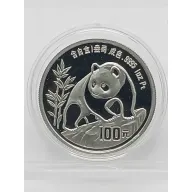
The Platinum Panda is one of the more unusual entries in modern platinum bullion. Produced intermittently by the China Gold Coin Corporation (CGCC) between 1987 and 2005, the series has not been struck since, leaving it suspended between active bullion programme and historical collectible. For buyers who encounter platinum Pandas on the secondary market, the coins carry the same annually changing panda design that has made the gold and silver versions iconic since 1982, combined with the scarcity of a discontinued product.
CGCC, a state-owned enterprise under the People's Bank of China, strikes Pandas at multiple facilities including Beijing, Shanghai, Shenyang, and Shenzhen. No standardised mintmarks are used, making attribution to a specific mint difficult for any given coin. The platinum version shares the legal tender status of its gold and silver siblings, denominated in Chinese Yuan, though the face values varied across different production years.
Platinum Pandas were produced at .9995 fineness (99.95%), matching the standard investment-grade purity used by all major sovereign mint platinum coins. Sizes ranged from 1/20 oz to 1 oz depending on the year, with availability and denominations shifting inconsistently across the production window. The discontinuation after 2005 means that platinum Pandas have not been part of the series' evolution since the weight system switch from troy ounces to metric grams in 2016, so all existing platinum Pandas are denominated in the original troy ounce format.
The Panda series as a whole occupies a hybrid position between pure bullion and numismatic product. The annually changing reverse design, featuring a new giant panda illustration each year, creates collector premiums that other bullion series lack. For the platinum version, this collector dimension is amplified by the discontinued status and lower original production volumes compared to the gold and silver editions.
Platinum Panda Denominations and Specifications
| Denomination | Weight | Purity | Production years |
|---|---|---|---|
| 1 oz (100 yuan) | 31.103 g | .9995 | 1987-1990, 1993-1997, 2002-2005 |
| 1/2 oz (50 yuan) | 15.552 g | .9995 | Select years |
| 1/4 oz (25 yuan) | 7.776 g | .9995 | Select years |
| 1/10 oz | 3.110 g | .9995 | Select years |
| 1/20 oz | 1.555 g | .9995 | Select years |
Face values were not consistent across all production years. The 1 oz denomination carried a 100 yuan face value for most of its run, but denomination assignments shifted for fractional sizes.
Design
The obverse features the Hall of Prayer for Good Harvests (Qinian Dian) at the Temple of Heaven complex in Beijing, the same design element used across all Panda coins since 1982 and the only part of the coin that has never changed. Inscriptions include Zhonghua Renmin Gongheguo (People's Republic of China) and the year of issue.
The reverse carries the annually changing giant panda illustration. Each year's panda is depicted in a different pose: eating bamboo, playing, resting, walking, or with cubs. This annual rotation applied to the platinum version during its production years, meaning each vintage carries a unique reverse design.
Platinum Panda Tax and Legal Status
The Platinum Panda is legal tender of the People's Republic of China, which affects its tax treatment in several jurisdictions. As a discontinued series available only on the secondary market, tax implications centre on the purchase and disposal of pre-owned coins.
- United Kingdom: Platinum coins are subject to 20% VAT on purchase. The Panda is not UK legal tender, so it does not qualify for CGT exemption. Capital gains are taxed at the individual's rate (18-24%, with a GBP 3,000 annual allowance). Pre-owned platinum coins purchased through the margin scheme may carry a reduced effective VAT rate at certain dealers.
- United States: Platinum is classified as a collectible for tax purposes, with a maximum long-term capital gains rate of 28%. IRA eligibility for Platinum Pandas is uncertain. The IRS does not generally recognise the Chinese mint as an approved foreign mint for gold IRA purposes, and this ambiguity extends to platinum. The .9995 purity exceeds the 99.95% IRA minimum for platinum, but custodian acceptance varies. Investors should verify with their specific IRA custodian before purchasing.
- Canada: Platinum at 99.5% purity or above is GST/HST-exempt. The Platinum Panda qualifies at .9995 fineness. Capital gains follow the standard 50% inclusion rate.
- Australia: Platinum at 99% purity or above in coin form is GST-free. The Panda qualifies. Capital gains tax applies with a 50% discount for holdings exceeding 12 months.
- Singapore: Platinum coins at 99% purity or above that are or were legal tender qualify as Investment Precious Metals (IPM), exempt from 9% GST. The Platinum Panda meets both criteria. No capital gains tax applies.
- Hong Kong: No sales tax, import duty, or capital gains tax on platinum. Fully tax-free.
- South Africa: Platinum coins attract 15% VAT. No exemption equivalent to the gold Krugerrand zero-rating exists for platinum. Capital gains are taxed at a 40% inclusion rate.
A Discontinued Chapter in the Panda Series
The Platinum Panda's production history is fragmented across three separate windows. The first run (1987-1990) coincided with platinum's early emergence as a retail investment metal, shortly after the Canadian Maple Leaf brought platinum coins into the mainstream in 1988. The second window (1993-1997) covered the period when platinum consistently traded above gold, making platinum bullion more attractive to investors. The third and final window (2002-2005) preceded a period of declining interest in platinum bullion from Chinese producers.
The discontinuation after 2005 is notable because it came before the broader platinum coin expansion that saw the Austrian Philharmonic (2016), British Britannia (2018), and Australian Kangaroo (2018) all enter the platinum market. The CGCC chose not to participate in this revival, leaving the Platinum Panda as a historical artefact while its gold and silver counterparts continued to evolve. The gold and silver Pandas underwent their significant weight system change in 2016, switching from troy ounces to metric grams. All existing Platinum Pandas predate this change and remain in the original troy ounce denominations.
The broader Panda series began in 1982 with the Gold Panda, China's first modern gold bullion coin. The Silver Panda followed in 1983, initially as a proof product at .900 fineness that did not settle into its current .999 bullion format until 1989 (with no production at all in 1986 or 1988). The Platinum Panda fits a pattern of experimentation across metals that characterised the series' early decades, including a limited Palladium Panda (.9995 Pd) produced in very small quantities.
The 2001-2002 period saw a design controversy across the entire Panda series. A design freeze was announced for 2001, resulting in the 2002 coin carrying an identical reverse to the 2001 issue. The collector backlash was severe enough to reverse the policy, and annual design changes resumed from 2003. Platinum Pandas from this period share whatever design was current for their production year.
Platinum Panda vs Modern Platinum Coins
Comparing the Platinum Panda to current sovereign mint platinum coins requires acknowledging a fundamental difference: the Panda is a discontinued secondary-market product, while its competitors are actively produced. This affects availability, pricing, and liquidity in ways that override simple specification comparisons.
Against the Platinum Maple Leaf (Royal Canadian Mint, in production since 1988), the Panda shares the same .9995 purity but lacks the Maple Leaf's continuous production history, globally consistent availability, and the Royal Canadian Mint's Bullion DNA authentication system. The Maple Leaf also benefits from being denominated in a major currency ($50 CAD face value) with clear IRA eligibility in the United States.
The American Platinum Eagle (US Mint, since 1997) carries stronger dealer support in the US market and unambiguous IRA eligibility, which the Platinum Panda lacks. The Eagle is available in four fractional sizes (1 oz, 1/2 oz, 1/4 oz, 1/10 oz), matching the Panda's historical range but with current production and modern security features.
The Platinum Britannia (Royal Mint, since 2018) offers the significant advantage of CGT exemption for UK buyers, a benefit no foreign coin can match. The Britannia's .9995 purity matches the Panda, but its active production, advanced security features, and UK legal tender status make it the more practical choice for UK-based platinum investors.
The Panda's distinguishing characteristic is its collector dimension. The annually changing design, combined with the discontinued status and limited original mintages, creates secondary-market premiums that other platinum coins do not carry. Buyers interested in the Panda specifically should factor in the counterfeiting risk that affects the broader Panda series more heavily than other sovereign mint products. NGC (Numismatic Guaranty Company) has flagged that counterfeit Pandas are produced "at an alarming rate," and purchasing from reputable dealers or buying third-party certified coins is strongly recommended for all Panda products.