6 products · 14 deals
Filters
| Product | /oz | Premium | Price | |
|---|---|---|---|---|

7 deals
|
$4,420.37 | +1.73% |
$71,058.98
£53,251
|
Compare |

3 deals
|
$4,448.14 | +2.37% |
$71,505.48
£53,585
|
Compare |
| $4,482.39 | +3.14% |
$72,055.98
€62,876
|
View Deal | |
| $4,482.39 | +3.14% |
$72,055.98
€62,876
|
View Deal | |
| $4,499.57 | +3.44% |
$72,332.13
A$101,590
|
View Deal | |
| $4,470.69 | +3.97% |
$71,867.97
NZ$125,848
|
View Deal |
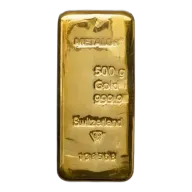
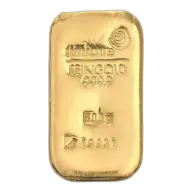

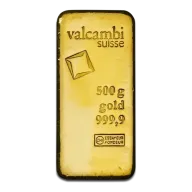

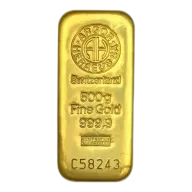

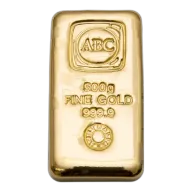

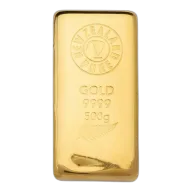
Prices are fetched automatically and may not reflect current merchant prices. Currency conversions and tax treatment are approximate. Rankings are based solely on price. We are not a dealer and accept no responsibility for transactions with listed merchants. Past performance is not indicative of future results. This site does not provide investment advice. Full disclaimer
About 500g Gold Bars
500g Gold Bars: Near-Institutional Pricing at Half-Kilo Scale
A 500g gold bar contains half a kilogram (16.075 troy ounces) of gold, placing it at the upper end of the retail bar market. At current prices, a single 500g gold bar is valued at approximately $53,000 or more, making this a product for serious investors, wealth managers, and individuals making substantial allocations to physical gold. The 500g format occupies a strategic middle ground between the widely traded 100g bar and the 1 kg (kilo) bar, which carries the lowest retail premiums available.
The premium compression from 100g to 500g is meaningful. A 100g gold bar typically carries premiums of 2-4% above spot, while 500g bars sit in the 1.5-3% range, approaching the near-institutional pricing of kilo bars. For an investor allocating $50,000 or more to gold, the difference between a 3% premium on 100g bars and a 2% premium on a single 500g bar represents a saving of several hundred dollars, money that buys more gold rather than more margin for the dealer.
The 500g weight is a metric standard, most popular in German-speaking Europe (Germany, Austria, Switzerland) where metric gold bar investment has deep cultural roots. UK and US markets trade primarily in troy ounce denominations, so 500g bars are available but less commonly stocked than their troy ounce equivalents. Australian buyers have access to Perth Mint 500g bars as a domestic option.
This weight class is produced exclusively by major LBMA-accredited refiners: Heraeus, Umicore, PAMP Suisse, Valcambi, Argor-Heraeus, and Perth Mint among others. Bars at this level are serialised, assayed, and typically sold with individual certificates. The combination of near-institutional premiums, global LBMA liquidity, and compact physical size makes 500g bars attractive for wealth preservation at scale.
Premium Economics at Half a Kilogram
Premiums on 500g gold bars typically fall in the 1.5-3% range above spot price. This represents roughly half the percentage premium of a 100g bar and a fraction of the premium on a 1 oz bar. Only the 1 kg bar consistently offers lower premiums, at approximately 1-2% above spot.
The premium advantage of 500g over smaller bars is substantial in absolute terms. On a $53,000 bar, the difference between a 2% premium (500g) and a 4% premium (buying the same weight in 100g bars) is over $1,000. That saving compounds across multiple purchases, making the 500g format meaningfully more cost-efficient for buyers with sufficient capital.
Cast bars at 500g carry lower premiums than minted bars. The production process for cast bars is simpler and cheaper, and at this size, cast bars are more common than minted. Minted bars in sealed assay packaging are available but command a slight premium for the additional security and presentation. For pure cost efficiency, cast bars from LBMA-accredited refiners offer the best value per gram.
The trade-off against 1 kg bars is divisibility versus premium. A 500g bar costs roughly half as much as a kilo bar, allowing the owner to sell half their position without liquidating everything at once. The kilo bar offers the lowest possible retail premium but requires selling the entire unit when raising cash. For investors who may need partial liquidity, holding two 500g bars provides better flexibility than one kilo bar, at a modest premium penalty.
Major 500g Gold Bars
The 500g gold bar market is dominated by European refiners, reflecting the metric weight system's strongest foothold in German-speaking and Continental European markets.
Heraeus is a German precious metals refiner headquartered in Hanau, LBMA-accredited, and one of the most trusted names in European bullion. The Heraeus 500g cast bar is a standard product in German and Austrian dealer inventories. Its strong domestic brand recognition means tight buyback spreads in European markets.
Umicore, a Belgian refiner with LBMA accreditation, produces a serialised 500g bar with certificate that is widely available across Europe. Umicore bars carry competitive premiums and are well recognised in Benelux and broader EU markets.
The 500g PAMP Suisse Fortuna bar brings the iconic Lady Fortuna design to the half-kilo format. At this weight, the PAMP brand premium is proportionally small, making the Fortuna's design appeal and VeriScan authentication available without a significant cost penalty relative to plain bars.
The 500g Argor-Heraeus bar offers Swiss LBMA credentials with the understated Classic design. Argor-Heraeus is one of only seven LBMA referees globally, the organisations that audit other refiners for Good Delivery compliance, giving its bars a particular weight of institutional authority.
Valcambi and Perth Mint also produce 500g bars, rounding out a market where every major LBMA refiner has a presence. For Australian buyers, the Perth Mint 500g bar provides a locally produced, GST-free option without the need for importation.
Liquidity and Storage at 500 Grams
Liquidity for 500g gold bars from LBMA-accredited refiners is good in European markets, where the metric weight system is standard and dealers routinely trade in gram-denominated bars. Heraeus, Umicore, PAMP, Valcambi, and Argor-Heraeus bars are bought back without hesitation by dealers across Germany, Switzerland, Austria, the UK, and broader Europe.
In the US market, liquidity is slightly lower because troy ounce bars (1 oz, 10 oz, kilo) are more commonly traded. A 500g bar from a recognised LBMA refiner will still find a buyer through any major US dealer, but the bar may not be an everyday inventory item. Similarly, in Asian markets, kilo bars dominate the large-bar segment, positioning 500g as a less standard denomination. The bar remains tradeable but may take marginally longer to sell at optimal pricing.
The high absolute value of a 500g gold bar (around $53,000 or more) narrows the buyer pool to individuals and institutions capable of a five-figure single transaction. This is the primary liquidity constraint at this weight, not any lack of market recognition or dealer acceptance. The buy-sell spread on LBMA-accredited 500g bars is tight, typically a fraction of a percent.
Storage is extremely compact for the value represented. A 500g gold bar is roughly the size of a small smartphone, easily fitting in a home safe, safe deposit box, or professional vault. Professional vault storage is common for holdings at this level, with fees typically charged as a percentage of stored value. The compact size of gold at 500g means even substantial allocations require minimal physical space, a stark contrast to the same value held in silver bullion, where 500g of metal represents just a few hundred dollars.
500g Gold Bars: frequently asked questions
-
The metal value of a 500g gold bar is $4,408.10 per troy ounce multiplied by 500g of gold content. That gives the raw melt value; dealer prices sit above this by a premium that varies by brand and supplier, as shown in the listings on this page.
-
Investment-grade 500g gold bars are typically 999.9 fine (24 carat), the standard purity for most major refiners. Some 22-carat (916 fine) bars exist but are not considered standard bullion grade and are less commonly traded among investors.
-
A 500g bar is a high-value single item, so storage deserves careful thought. Options include a home safe (anchored, fire-rated), a bank safe-deposit box, or allocated storage with a specialist vault. Whichever you choose, make sure your insurance policy covers the full replacement value of physical gold.
-
In most markets, buying gold itself triggers no purchase declaration. In the US, reporting requirements apply to certain sale transactions, not purchases. In the UK, no declaration is required when buying; gains on sale may fall within your annual CGT allowance of £3,000. In Canada, 50% of any gain is included in taxable income. Always check current rules with a tax adviser.
- 500g ABC Cast Bar Gold Bar
- 500g Ainslie Gold Bar
- 500g Argor-Heraeus Gold Bar
- 500g Austrian Mint Gold Bar
- 500g Degussa Gold Bar
- 500g Fortuna Gold Bar
- 500g Go Gold Bar
- 500g Gold Bar
- 500g Gold Bullion Australia Gold Bar
- 500g Golden State Mint Gold Bar
- 500g Heraeus Gold Bar
- 500g Metalor Gold Bar
- 500g PAMP Suisse Gold Bar
- 500g The Royal Mint Gold Bar
- 500g UBS Gold Bar
- 500g Umicore Gold Bar
- 500g Valcambi Gold Bar
- Pre-Owned 500g Austrian Mint Gold Bar
- Pre-Owned 500g Baird Cast Bar Gold Bar
- Pre-Owned 500g Baird & Co. Gold Bar
- Pre-Owned 500g Gold Bar
- Pre-Owned 500g Johnson Matthey Gold Bar
- Pre-Owned 500g The Royal Mint Gold Bar
- Pre-Owned 500g Umicore Gold Bar