0 products · 0 deals
Filters
No products match your filters.
Prices are fetched automatically and may not reflect current merchant prices. Currency conversions and tax treatment are approximate. Rankings are based solely on price. We are not a dealer and accept no responsibility for transactions with listed merchants. Past performance is not indicative of future results. This site does not provide investment advice. Full disclaimer
About the American Eagle Platinum
America's Flagship Platinum Coin
The American Platinum Eagle is the official platinum bullion coin of the United States, first struck in 1997. It joined the Gold Eagle (1986) and Silver Eagle (1986) as the third metal in the American Eagle programme, which was authorised by the Gold Bullion Coin Act of 1985 and the Liberty Coin Act of 1985. The weight, content, and purity of every coin are guaranteed by the US Government.
Struck in .9995 fine platinum, the coin carries a $100 face value, which was the highest denomination ever placed on a US coin when it was introduced. The 1 oz version is the primary bullion product; fractional sizes (1/2, 1/4, and 1/10 oz) were produced from 1997 until 2014, when the US Mint discontinued fractional platinum Eagles for the bullion market. Only the 1 oz bullion version remains in production.
The Platinum Eagle is the most recognised platinum coin in North America and one of the most traded platinum bullion products globally. For US investors, it carries a significant advantage: American Eagles receive a specific exemption in IRA rules, making the Platinum Eagle eligible for inclusion in self-directed precious metals IRAs regardless of the usual purity requirements. The .9995 purity also exceeds the IRS minimum threshold in its own right. Combined with the government weight guarantee and broad dealer recognition, the Platinum Eagle is the default sovereign platinum coin for the US market.
Platinum Eagle Denominations and Dimensions
| Size | Face value | Weight | Diameter | Purity |
|---|---|---|---|---|
| 1 oz | $100 | 31.120g | 32.70 mm | .9995 |
| 1/2 oz | $50 | 15.560g | 27.00 mm | .9995 |
| 1/4 oz | $25 | 7.780g | 22.00 mm | .9995 |
| 1/10 oz | $10 | 3.112g | 16.50 mm | .9995 |
All denominations are .9995 fine platinum, the universal standard for sovereign-mint platinum coins. The fractional sizes (1/2, 1/4, and 1/10 oz) were discontinued for bullion production after 2014. Proof versions in fractional sizes have been produced intermittently since then, but the regular bullion programme is now 1 oz only.
The 2021 redesign introduced Type II versions across the American Eagle programme. Type II Platinum Eagles carry anti-counterfeiting edge features (a specific missing-reed position that varies by year), matching the security enhancements added to the Gold and Silver Eagles in the same transition.
The .9995 purity standard is universal across all five major sovereign-mint platinum coins. Platinum's metallurgical properties make refining to four-nines (.9999) purity extremely difficult, unlike gold where .9999 is standard for most modern bullion coins. The 1 oz coin's total weight of 31.120g reflects the nearly pure platinum content with minimal alloy, contrasting with the Gold Eagle's approach of adding copper and silver alloy to bring the total coin weight above the stated gold content.
Platinum Eagle Tax Treatment by Country
The American Platinum Eagle is US legal tender with a face value of $100, though its platinum content makes it worth far more. Tax treatment varies significantly across jurisdictions, and platinum is treated less favourably than gold in several countries.
- United States: No federal sales tax on legal tender coins. Most states exempt investment precious metals, including platinum; roughly 35 states fully exempt bullion. IRA eligible with an approved custodian. American Eagles receive a specific statutory exemption from IRA purity requirements, so the Platinum Eagle qualifies for self-directed precious metals IRAs even though the standard IRS requirement for platinum is 99.95% (which it also meets). Capital gains are taxed at the 28% collectibles rate for long-term holdings. Dealers must file IRS Form 1099-B for certain bulk sales.
- United Kingdom: Platinum bullion carries 20% VAT on purchase. American Eagles are not UK legal tender, so CGT applies on disposal at 18-24% rates (£3,000 annual allowance). The 1 oz Platinum Britannia is CGT-exempt in the UK as British legal tender, making it the more tax-efficient choice for UK-based platinum investors on the exit side.
- Canada: GST/HST exempt as platinum bullion at .9995 purity (exceeds 99.5% threshold). American Eagles are not RRSP-eligible in Canada, as the programme only qualifies coins from the Royal Canadian Mint.
- Australia: The Platinum Eagle's .9995 purity exceeds Australia's 99% GST exemption threshold for platinum in coin form. GST-free.
- New Zealand: GST-exempt as fine platinum above 99% purity. No capital gains tax in NZ.
- Singapore: GST-exempt under the IPM scheme for qualifying legal tender platinum coins above 99% purity.
- Hong Kong: No sales tax, no import duty, no capital gains tax.
- South Africa: 15% VAT applies on platinum coins. No domestic legal tender exemption applies to US coinage.
- European Union: Platinum coins are subject to local VAT rates (17-27%). The investment gold exemption (Directive 98/80/EC) does not cover platinum. Some member states may offer margin scheme treatment on pre-owned platinum coins.
The Platinum Eagle Since 1997
The American Platinum Eagle launched in 1997, over a decade after the Gold and Silver Eagles established the American Eagle brand. Platinum was a relative latecomer to the sovereign bullion coin market. The Canadian Platinum Maple Leaf (1988) and the Australian Koala (1987) predated the Eagle, and the Isle of Man Noble (1983) holds the distinction of being the first modern platinum bullion coin, though it was discontinued in 1989.
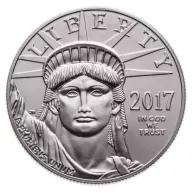
The obverse features a Statue of Liberty portrait looking over her shoulder, a design unique to the Platinum Eagle within the American Eagle programme. The gold version uses the Saint-Gaudens Lady Liberty, and the silver uses the Weinman Walking Liberty, so each metal has its own distinct identity. The reverse has changed over the series' life. Bullion versions used a soaring eagle design from 1997 to 2017, with a new design introduced in 2018. Proof versions have changed their reverse design annually, a feature mandated to maintain collector interest.
The 2021 Type I to Type II transition affected all three metals in the American Eagle programme simultaneously. For platinum, this meant the addition of anti-counterfeiting edge features matching those introduced on the Gold and Silver Eagles. Both Type I and Type II versions were produced in 2021, making it the only year with two distinct reverse designs in the bullion series.
Fractional platinum Eagles (1/2, 1/4, and 1/10 oz) were produced from 1997 through 2008 in all four sizes, with intermittent production afterward. The US Mint ceased regular bullion production of fractional sizes after 2014, though proof fractionals have appeared in limited collector releases. This reflects the broader market reality that fractional platinum coins carry very high premiums (15-30% above spot) and are rarely cost-efficient for investment purposes.
Platinum Eagle vs Maple Leaf, Britannia, and Philharmonic
Five sovereign mints produce 1 oz platinum bullion coins, all at .9995 fine purity. The American Eagle, Canadian Maple Leaf, British Britannia, Australian Kangaroo, and Austrian Philharmonic are all government-backed and widely accepted. The differences between them come down to premiums, tax treatment, design, and market positioning.
On premiums, the Eagle typically commands the highest price of the five in the US market, reflecting strong domestic demand and broad IRA eligibility. The Maple Leaf and Philharmonic are often the most competitively priced, particularly through European and Canadian dealers. The Britannia occupies a middle ground but offers a unique tax advantage for UK buyers: CGT exemption as British legal tender. No other platinum coin offers this benefit in the UK.
The Eagle is the only platinum coin in this group with a 22-karat gold counterpart. The Gold Eagle uses a .9167 fine alloy with copper and silver for durability, while the Platinum Eagle is .9995 fine. This purity difference is not a choice by the US Mint; it reflects the fact that virtually all platinum bullion is produced at 999.5, as the metal's refining characteristics make achieving higher purity extremely difficult. There is no widespread four-nines (.9999) platinum product in the market.
For North American buyers, the Eagle's IRA exemption and domestic dealer network make it the natural first choice. For UK buyers, the Britannia's CGT exemption is a substantial advantage. For buyers focused purely on lowest premium per ounce of platinum, the Maple Leaf and Philharmonic typically offer the best value.