0 products · 0 deals
Filters
No products match your filters.
Prices are fetched automatically and may not reflect current merchant prices. Currency conversions and tax treatment are approximate. Rankings are based solely on price. We are not a dealer and accept no responsibility for transactions with listed merchants. Past performance is not indicative of future results. This site does not provide investment advice. Full disclaimer
About the American Palladium Eagle Platinum
The American Palladium Eagle: A Rare Metal on Platinum Pages
The American Palladium Eagle is the official palladium bullion coin of the United States, first issued in September 2017. It was authorised by the American Eagle Palladium Bullion Coin Act of 2010, signed by President Obama in December 2010, though the US Mint delayed production for seven years. A CPM Group market study in 2012 concluded that demand "would most likely not be sufficient to sustain a market in palladium bullion coins." The 2017 inaugural issue sold out on day one.
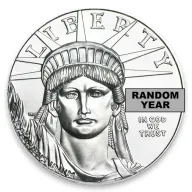
The coin is struck in .9995 fine palladium (not platinum, despite appearing in platinum dealer inventories due to shared product categories). Both the obverse and reverse designs come from sculptor Adolph Alexander Weinman, making it the only US bullion coin where both sides are by the same historical designer. The obverse features the "Winged Liberty" from the Mercury dime (1916-1945), and the reverse is based on Weinman's 1907 American Institute of Architects medal, showing an eagle pulling a laurel branch from a rock.
Total cumulative production through 2024 is approximately 89,669 coins, making the entire series smaller than many single-year issues of other American Eagle coins. Congress mandated that the surface treatment must differ each year, resulting in alternating finishes: bullion, proof, reverse proof, and uncirculated. This rotation maintains collector interest and gives each year a distinct character.
Palladium Eagle Specifications and Mintage History
| Attribute | Value |
|---|---|
| Metal | .9995 fine palladium |
| Weight | 31.120g (1.0005 troy ounces) |
| Diameter | 34.036 mm (1.340 inches) |
| Edge | Reeded |
| Face value | $25 USD |
| Finish | Rotates annually (bullion/proof/reverse proof/uncirculated) |
| Mint | West Point |
| Legal tender | United States |
Annual Mintage
| Year | Finish | Mintage |
|---|---|---|
| 2017 | Bullion | 15,000 |
| 2018-W | Proof | 14,986 |
| 2019-W | Reverse Proof | 18,839 |
| 2020-W | Uncirculated | 9,746 |
| 2021-W | Proof | 5,170 |
| 2021 | Bullion | 8,700 |
| 2022-W | Reverse Proof | 7,433 |
| 2023-W | Bullion | 5,778 |
| 2024-W | Proof | 4,017 |
The 2024 proof (4,017 coins) and 2021 bullion (8,700 coins) represent the lowest production runs in the series. Both sides are struck in high relief, honouring Weinman's original artistic intent, which was compromised by the flat-relief requirements of 20th-century circulation coinage. The "W" mint mark on collector versions identifies West Point production. Bullion versions carry no mint mark.
The $25 face value is set nominally by statute; the palladium content makes each coin worth many times the denomination. The coin's diameter of 34.036 mm is slightly larger than the Platinum Eagle's 32.70 mm, reflecting the different density of palladium (12.02 g/cm3) compared to platinum (21.45 g/cm3). A palladium coin must be physically larger than a platinum coin of the same troy ounce weight because palladium is substantially less dense.
Palladium Eagle Tax Treatment
The American Palladium Eagle is US legal tender at $25 face value, though its metal value is many times higher. Palladium has a distinct tax position in several jurisdictions, differing from both gold and platinum.
- United States: No federal sales tax on legal tender coins. IRA eligible as one of the very few palladium coins that qualifies for self-directed precious metals IRAs. The .9995 purity meets the IRS minimum requirement. Capital gains are taxed as collectibles at up to 28% federal rate. State sales tax exemptions vary; most states exempting bullion include palladium.
- United Kingdom: Palladium is subject to 20% VAT, the same treatment as silver and platinum. Not UK legal tender, so CGT applies at 18-24% rates above the £3,000 annual allowance. No exemption or reduced rate is available for palladium.
- Canada: Palladium is explicitly NOT exempt from GST/HST, unlike gold, silver, and platinum. This is a notable exception in Canadian tax law; the federal precious metals exemption covers gold, silver, and platinum at sufficient purity but does not extend to palladium. Full GST (5%) or HST (13-15%) applies.
- Australia: Palladium is not listed among the investment-grade precious metals eligible for GST exemption. The 10% GST likely applies.
- Singapore: Palladium is not covered under the IPM (Investment Precious Metals) scheme. The 9% GST applies.
- Hong Kong: No sales tax, no import duty, no capital gains tax. The one jurisdiction where palladium receives no disadvantage relative to other metals.
- European Union: Full local VAT rates apply to palladium. The investment gold exemption does not cover palladium.
Weinman's Mercury Dime Reborn in Palladium
Adolph Alexander Weinman (1870-1952) was a German-born American sculptor whose coin designs are among the most celebrated in US numismatic history. His Walking Liberty half dollar (1916-1947) was adapted for the American Silver Eagle, and his Mercury dime (1916-1945) was revived for the Palladium Eagle. The Mercury dime's name is a misnomer: the winged cap on Liberty's head is a Phrygian cap symbolising freedom of thought, not the winged helmet of the Roman god Mercury. The confusion has persisted for over a century.
The Palladium Eagle's reverse is drawn from Weinman's 1907 medal for the American Institute of Architects, depicting an eagle with upraised wings pulling a laurel branch from a rock. This design had never appeared on US coinage before the Palladium Eagle brought it to a circulating-denomination context. The high-relief format was chosen to honour Weinman's original artistic depth, which the mechanical constraints of early 20th-century coinage production had forced into flatter relief.
The 2018 proof version sold out within five minutes of release, with secondary market sales commanding premiums of $600 over the Mint's asking price. This instant sellout confirmed the CPM Group's 2012 pessimism was misplaced, at least regarding collector demand. Palladium had not been used in US coinage before 2017, making the Palladium Eagle a genuine first for the US Mint.
The congressionally mandated rotating finish (bullion, proof, reverse proof, uncirculated) means no two consecutive years share the same surface treatment. This requirement, written into the authorising legislation, was designed to distinguish annual issues and sustain collector interest across the series. With total production under 90,000 coins across all years, the entire Palladium Eagle programme is smaller in aggregate than many single-year issues of American Silver Eagles, which have exceeded 40 million in peak years.
Palladium Eagle vs Other Palladium and Platinum Products
Palladium bullion coins are exceptionally rare compared to gold, silver, or platinum. The entire global catalogue of sovereign-mint palladium coins consists of only a handful of products. The Canadian Palladium Maple Leaf from the Royal Canadian Mint is the primary competitor: .9995 purity, $50 CAD face value, higher mintages, and wider dealer availability. For investors seeking palladium specifically, the Maple Leaf is the more accessible and liquid option. The American Palladium Eagle is the scarcer, more collectible alternative.
The Russian Palladium Ballerina (.999 purity) was produced during the Soviet and early post-Soviet era and has been discontinued. It trades on the secondary market through specialist dealers. The Isle of Man Palladium Noble (2012) was a one-off issue of extreme rarity. These limited options reflect palladium's niche position in the retail bullion market.
Against platinum coins like the 1 oz Platinum American Eagle, the Palladium Eagle occupies a different market. Platinum has five competing sovereign coins and a more established dealer infrastructure. Palladium has effectively two sovereign coins (American and Canadian), fewer stocking dealers, and wider bid-ask spreads. The metals also have different industrial demand drivers: platinum is dominated by automotive catalytic converters and industrial uses, while palladium's demand is similarly automotive-heavy but has been disrupted by the substitution trend toward platinum in gasoline catalytic converters.
The Palladium Eagle's low mintages (under 90,000 total) give it a collector dimension that standard bullion products lack. Vintage years command premiums well above metal value, particularly the 2017 inaugural issue and the 2018 rapid sellout. This dual identity, as both a precious metals product and a collectible, distinguishes it from the more straightforward bullion positioning of the Platinum Eagle.
American Palladium Eagle Platinum: frequently asked questions
-
The price of a 1 oz American Palladium Eagle tracks the live palladium spot price ($1,750.00) plus a dealer premium. Mintages are among the lowest of any US Mint bullion programme, so these coins typically carry a collector premium well above melt value. BullionFerret compares 1 listing from 1 dealer so you can find the keenest price.
-
The current palladium spot price is $1,750.00. The relationship between palladium and platinum prices has shifted significantly over the years: palladium traded well above platinum during the peak autocatalyst-demand period, then fell sharply as electric vehicle adoption reduced gasoline-engine demand. Check the live spot prices for both metals to see today's relationship.
-
Three structural forces have driven palladium lower. First, the global shift toward electric vehicles reduces demand for catalytic converters, which are the dominant end-use for palladium. Second, Russian palladium exports normalised after earlier disruption. Third, automakers have been substituting cheaper platinum into catalysts where possible. These are long-term demand shifts, not temporary dips.
-
Catalytic converters in petrol and hybrid vehicles are the dominant end-use for palladium, making automotive production and emissions regulations the main price driver. Electronics and dentistry make up most of the remainder. Palladium is mined primarily in Russia and South Africa, so supply disruptions in either country can move the price sharply.
-
By annual mine output, palladium is rarer than gold. Annual palladium production is a small fraction of annual gold production, and above-ground palladium stockpiles are also much smaller. That relative scarcity is partly why industrial demand swings have historically produced large price moves in the palladium market.