
 APMEX
APMEX

Prices are fetched automatically and may not reflect current merchant prices. Currency conversions and tax treatment are approximate. Rankings are based solely on price. We are not a dealer and accept no responsibility for transactions with listed merchants. Past performance is not indicative of future results. This site does not provide investment advice. Full disclaimer
About the 10 oz Engelhard Platinum Bar
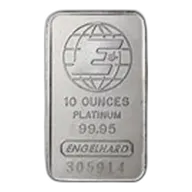
Engelhard 10 oz Platinum Bar
The 10 oz Engelhard Platinum Bar is a legacy product from one of America's most historically significant precious metals refiners. Engelhard Corporation operated from 1902 until its acquisition by BASF in 2006, during which time it was a dominant force in precious metals refining, fabrication, and industrial applications. Engelhard bars are no longer manufactured, making every existing bar a secondary-market product with a fixed and declining supply as bars are lost, melted, or placed in permanent collections.
Engelhard's significance in the platinum market is particularly notable. The company was a pioneer in platinum group metals processing and held a leading position in industrial platinum applications, including the development of automotive catalytic converters that now account for nearly 38% of global platinum demand. Their refinery held full LBMA accreditation during its operating years, and their platinum bars were produced to the standard 999.5 fine purity.
The collectible premium on Engelhard bars varies substantially by metal: Engelhard silver bars carry significant collector premiums due to their popularity among vintage bullion collectors, while platinum bars trade closer to their metal value due to the smaller collector base for platinum products generally. A 10 oz Engelhard platinum bar will typically command a modest premium over generic equivalents, reflecting brand recognition and the historical significance of the Engelhard name rather than intense collector demand. For buyers seeking a liquid 10 oz platinum bar at the lowest possible premium, a current-production bar from PAMP Suisse or the Perth Mint will be more cost-effective.
For those who value American refining heritage and provenance, the Engelhard carries a distinction that newer bars cannot replicate. The company's name is synonymous with precious metals in the US market, and its bars remain instantly recognisable to experienced dealers.
Engelhard 10 oz Platinum Bar Specifications
| Attribute | Detail |
|---|---|
| Weight | 10 troy ounces (311.035 grams) |
| Purity | 999.5 fine platinum (99.95%) |
| Manufacturer | Engelhard Corporation |
| Country of origin | United States |
| Manufacturer type | Refinery (legacy; ceased operations after 2006 BASF acquisition) |
| Accreditation | LBMA accredited (historical) |
| Serial number | Stamped on bar |
| Production period | Pre-2006 |
Engelhard platinum bars were produced in both poured (cast) and stamped (minted) varieties depending on the era and size. The 10 oz size was manufactured primarily as a minted bar with Engelhard's distinctive hallmark, serial number, weight, and purity clearly stamped into the metal surface. As a legacy product, individual bars may show light handling marks or surface variation consistent with their age, though platinum does not tarnish, corrode, or degrade under normal storage conditions. The metal remains in the same essential condition as when produced.
Authentication of Engelhard platinum bars relies on the stamped serial number, precise weight verification, the distinctive Engelhard hallmark style (which varied by production era), and XRF or sigma testing for metal composition. Platinum's extremely high density (21.45 g/cm3) is itself an authentication aid: no common cheap metal is dense enough to substitute convincingly in a bar of correct dimensions. The closest alternatives (osmium, iridium) are rarer and more expensive than platinum itself. Tungsten at 19.25 g/cm3 would be detectably lighter, and its lower density would be apparent in a properly dimensioned bar.
The bar's discontinued status means condition and serial number verification are particularly important for resale. Dealers experienced with Engelhard products can verify the hallmark style against known production eras, providing additional confidence beyond physical testing.
Tax Treatment of the 10 oz Engelhard Platinum Bar
Despite being a legacy product no longer in production, the Engelhard platinum bar receives the same tax treatment as any 999.5 fine platinum bar currently manufactured. The bar's age, discontinued status, and vintage character do not alter its classification as investment-grade platinum bullion in any jurisdiction. Tax authorities assess purity and form, not production date or manufacturer status.
Key Jurisdictions
- United States: Most states exempt investment precious metals from sales tax. The 28% maximum collectibles CGT rate applies to long-term gains. IRA eligibility requires 99.95% purity from accredited manufacturers; Engelhard's historical LBMA accreditation should satisfy most IRA custodian requirements, though buyers should confirm acceptance with their specific custodian before purchase, as policies vary on legacy refiner products.
- Canada: GST/HST exempt at 99.5%+ purity in bar form. No distinction between current and legacy production.
- United Kingdom: 20% VAT on purchase. CGT applies on sale at 18-24% rates. No exemptions for bars regardless of age or origin.
- Australia: GST-free at 99%+ purity from an accredited refiner. Engelhard's historical LBMA accreditation is generally accepted.
- New Zealand: GST-exempt at 99%+ purity. No capital gains tax.
- Singapore: IPM eligibility may require verification with the dealer, as the LBMA accreditation is historical rather than current. The underlying metal purity (99.95%) satisfies the 99% minimum. Dealer confirmation is advisable.
- Hong Kong: No purchase tax or capital gains tax on any form of platinum.
- EU: Full national VAT rate (17-27%). No platinum exemption.
- South Africa: 15% VAT on platinum bars.
One consideration specific to legacy-brand bars: if the bar appreciates in value beyond its metal content due to collector demand for the Engelhard name, some jurisdictions may treat the collector-premium component differently. In practice, for a 10 oz platinum bar where metal value dominates and collector premium is modest, this is unlikely to affect tax treatment materially.