1 listing
Filters
| Product | /oz | Premium | Price | |
|---|---|---|---|---|

 Essential Bullion
|
$2,176.93 |
+29.96%
+56% inc.VAT
|
$69,987.88
£63,465 inc.VAT
|
View Deal |
Prices are fetched automatically and may not reflect current merchant prices. Currency conversions and tax treatment are approximate. Rankings are based solely on price. We are not a dealer and accept no responsibility for transactions with listed merchants. Past performance is not indicative of future results. This site does not provide investment advice. Full disclaimer
About the 1 Kilo Metalor Platinum Bar
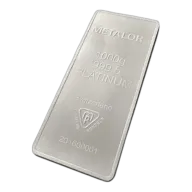
The 1 Kilo Metalor Platinum Bar
The 1 Kilo Metalor Platinum Bar contains 1,000 grams (32.15 troy ounces) of .9995 fine platinum from one of the four major Swiss refineries. Metalor is not just LBMA-accredited for gold; it is a Full Member of the London Platinum and Palladium Market (LPPM) and has sat on the LPPM Good Delivery referee panel since 2011, with a representative on the LPPM management committee. Its Swiss refinery has been processing platinum since 1924, when Switzerland's first precious metals refinery began producing 995-fine platinum alongside gold and silver. Few platinum bars on the retail market carry credentials of that depth.
The kilo format is the optimisation play in platinum. Bar premiums fall steeply with size: gram-weight platinum bars run 20-40% over spot, 1 oz bars 5-10%, and 1 kilo platinum bars roughly 3-6%, the most premium-efficient way to hold the metal. The trade-off is divisibility. A kilo bar is an all-or-nothing sale, and larger platinum bars have a thinner retail secondary market than gold equivalents, so buyers at this size are typically committing a meaningful sum for the long term rather than building a position they expect to unwind in pieces.
Platinum itself helps with the authentication question that haunts large bars. Its density of 21.45 g/cm3 has no cheap substitute: tungsten, the classic fake-gold filler, is detectably lighter at 19.25 g/cm3, and the only denser candidates (iridium, osmium) cost more than platinum. Counterfeit platinum bars are accordingly rare. Combined with the Metalor hallmark, a stylised M and P in an inverted triangle, the bar is straightforward to verify for anyone equipped to weigh and measure it.
1 Kilo Metalor Platinum Bar Specifications
| Attribute | Value |
|---|---|
| Weight | 1 kilogram (1,000g / 32.15 troy oz) |
| Purity | .9995 fine platinum |
| Refiner | Metalor Technologies (Switzerland) |
| Hallmark | Stylised M and P in an inverted triangle |
| Accreditation | LPPM Good Delivery (Metalor is an LPPM referee refinery) |
Metalor's main refinery sits at Marin-Epagnier in the Canton of Neuchâtel, where it has operated since 1947; it is the only one of the four major Swiss refineries (PAMP, Valcambi, Argor-Heraeus, Metalor) located outside Ticino. The Swiss facility uses government-accredited essayeurs jurés, licensed assayers operating under the Swiss Office for Precious Metals Control, which underwrites the purity stamped on the bar.
Platinum is a practical metal at this weight. It does not tarnish or corrode, so no atmospheric precautions are needed in storage, and at Mohs 3.5 it is harder and more scratch-resistant than gold. The density means a kilo of platinum occupies a compact footprint, stacking efficiently in a safe or vault, with a value-to-space ratio similar to gold. XRF surface testing and ultrasonic checks work on platinum bars exactly as they do on gold, and the density mismatch of any substitute metal makes a convincing fake extremely difficult to produce.
Tax Treatment of the 1 Kilo Metalor Platinum Bar
Platinum receives less generous tax treatment than gold in Europe, so where you buy matters more than it does for a gold kilobar.
- United Kingdom: 20% VAT on purchase, and as a bar with no legal tender status the gain is CGT-liable on sale. This is the least tax-efficient platinum form for UK investors; pre-owned bars sold under a dealer's margin scheme can soften the VAT hit.
- European Union: Full standard VAT applies (17-27% depending on country). The EU investment-gold exemption does not extend to platinum.
- United States: Most states exempt bullion from sales tax. At .9995 the bar exactly meets the IRS Section 408(m) purity threshold of 99.95% for platinum, so it is IRA-eligible when held by an approved custodian. Long-term gains are taxed at the collectibles rate of up to 28%.
- Canada: 0% GST/HST, since platinum refined to 99.5%+ purity in bar form is federally exempt. Capital gains taxable at the 50% inclusion rate.
- Australia: GST-free as investment-grade platinum at 99%+ purity. CGT applies, with the 50% discount after 12 months.
- New Zealand: GST-exempt (the platinum threshold is 99%+). No formal capital gains tax.
- Singapore and Hong Kong: Singapore exempts platinum at 99%+ purity as Investment Precious Metals and levies no CGT. Hong Kong has no sales tax, no import duty, and no CGT. Both are among the cheapest places in the world to hold a platinum kilobar.
Metalor: From Watchmaking Supplier to LPPM Referee
Metalor traces its origins to 1852, when Martin de Pury & Cie founded a small gold rolling mill in Le Locle, in the Swiss canton of Neuchâtel, to supply gold components to the local watchmaking industry. The Banque du Locle acquired the business in 1864, when it had roughly 30 workers, and Swiss Bank Corporation took it over in 1918. The pivotal moment for bullion buyers came in 1924, when Switzerland's first precious metals refinery commenced operations under the company, producing 999.9-fine gold and, soon after, 999-fine silver and 995-fine platinum. In 1934 it became the first Swiss refinery listed on the LBMA Good Delivery List.
The company was renamed Métaux Précieux SA Metalor in 1936 and moved its headquarters and main refinery to Marin-Epagnier in 1947, where the Swiss operation remains. International expansion followed from the 1960s: a Hong Kong refinery in 1982, a US refinery in Massachusetts in 1986, and a Singapore refinery inaugurated in 2014. Ownership changed hands several times after the SBC-UBS merger of 1998, passing from Swiss private investors to French private equity firm Astorg Partners in 2009, before Japan's Tanaka Kikinzoku Kogyo acquired 100% of the company in 2016, folding Metalor into the Tanaka Precious Metals group.
On the platinum side specifically, Metalor joined the LPPM Good Delivery referee panel in 2011 and is a Full Member of the LPPM. It is also one of only five global LBMA referee refineries (since 2004), a founding international board member of the Shanghai Gold Exchange, and an approved brand on COMEX and TOCOM. For a buyer, that history translates into a hallmark that any dealer or refiner on earth will recognise.
Metalor Kilo Platinum vs Other Bars and Platinum Coins
The direct alternatives are kilo platinum bars from the other LPPM-accredited Swiss and German refiners: PAMP Suisse, Valcambi, Heraeus, and Argor-Heraeus. All are produced to the same .9995 standard, and at this level the sensible buying rule is simple: the accreditation, not the logo, carries the value, so buy whichever recognised brand is cheapest on the day. The platinum bar market is small enough that not every dealer stocks every brand or size, so availability often decides the question before price does.
Down the weight scale, the comparison is premium versus flexibility. A 100g bar format in platinum runs roughly 4-8% over spot and 1 oz bars 5-10%, against 3-6% for the kilo. Ten smaller bars cost more per gram but can be sold one at a time; the kilo cannot. Buyers who may need partial liquidity should weigh that seriously, because larger platinum bars have a limited retail secondary market and may need to go to specialist dealers or refiners at resale.
Against platinum coins such as the Platinum Britannia or Perth Mint's platinum coins, the bar wins on price: the premium gap between platinum bars and coins is wider than the equivalent gap in gold, making the bar savings more meaningful. Coins answer back with sovereign-mint recognition and, for UK residents, the Britannia's CGT exemption, which a bar can never offer. In no-tax jurisdictions like Hong Kong and Singapore, where neither VAT nor CGT applies, the kilo bar's premium efficiency makes it the lowest-cost route into platinum available at retail.
1 Kilo Metalor Platinum Bar: frequently asked questions
-
The price we track is $69,987.88, currently about 30.0% over the $1,680.00 platinum spot price. At 1 kilogram (32.15 troy oz), this is a substantial platinum bar aimed at investors making a significant commitment to the metal. Price moves directly with platinum spot, scaled to its weight.
-
Platinum is one of the densest metals, with a density of approximately 21.4 g/cm³, so a 1 kg bar is surprisingly compact, occupying roughly 47 cubic centimetres. Despite its small size, a kilo of platinum is considerably heavier than it looks, which is a common surprise for first-time buyers.
-
LBMA-accredited bars from established refiners are routinely accompanied by assay documentation confirming weight and purity. Reputable dealers can verify authenticity before purchase, and buying from an LBMA-recognised dealer reduces the risk of counterfeit product. Checking that the bar bears the refiner's hallmark and a purity stamp of 999.5 is a basic first step.
-
Platinum has a much smaller investor market than gold or silver. Industrial demand, particularly from the automotive sector for catalytic converters, drives a large share of price moves, making platinum more sensitive to industrial cycles. The dealer network is narrower, bid-ask spreads tend to be wider, and fewer buyers are active in the secondary market compared to gold or silver.