1 listing
Filters

 APMEX
APMEX
Prices are fetched automatically and may not reflect current merchant prices. Currency conversions and tax treatment are approximate. Rankings are based solely on price. We are not a dealer and accept no responsibility for transactions with listed merchants. Past performance is not indicative of future results. This site does not provide investment advice. Full disclaimer
About the 50g Johnson Matthey Platinum Bar
The 50g Johnson Matthey Platinum Bar
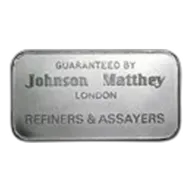
The 50g Johnson Matthey Platinum Bar is a legacy product from one of the most historically significant names in precious metals refining. Johnson Matthey, founded in London in 1817, was a dominant force in global precious metals processing for nearly two centuries before selling its refining operations to Asahi Refining (a Mitsubishi subsidiary) in 2015. No new JM bars are being produced, but existing bars continue to circulate on the secondary market and retain full recognition from dealers worldwide.
Johnson Matthey's relationship with platinum is particularly notable. The company was instrumental in developing platinum refining techniques in the 19th century and became one of the founding members of the London Platinum and Palladium Market (LPPM). Their expertise in platinum group metals was unmatched among Western refiners, extending to industrial applications (catalytic converters, fuel cells) as well as investment bars. The 50g platinum bar carries this heritage in tangible form.
At 999.5 fine platinum (1.6075 troy ounces), the bar meets the LPPM Good Delivery standard that JM helped establish. The hallmark, serial number, and JM crossed-hammer logo remain universally recognised authentication marks. Unlike bars from active refiners, JM bars cannot be replaced if packaging is damaged or serial numbers contested; this finite supply adds a modest collector dimension to what is fundamentally an investment product.
The secondary-market nature of JM bars means pricing varies more than for current-production alternatives. A sealed JM bar in original packaging commands a premium reflecting both metal content and brand heritage. A loose bar without documentation may trade at a slight discount to current-production equivalents from Valcambi or Argor-Heraeus, since dealers face verification costs without assay card support.
50g Johnson Matthey Platinum Bar Specifications
| Property | Detail |
|---|---|
| Weight | 50g (1.6075 troy oz) |
| Purity | 999.5 fine (99.95% platinum) |
| Manufacturer | Johnson Matthey (operations sold to Asahi Refining, 2015) |
| Country of origin | United Kingdom |
| Founded | 1817 |
| Status | No longer in production; secondary market only |
| Accreditation (historical) | LBMA, LPPM founding member |
| Hallmark | JM crossed-hammer logo, weight, purity, serial number |
| Face value | None (not legal tender) |
Johnson Matthey bars carry the distinctive JM hallmark featuring the crossed-hammer logo alongside stated weight and fineness. Serial numbers link each bar to JM's production records, though the company no longer maintains an active verification service for individual buyers. Authentication relies on dealer expertise, weight/dimension verification, and testing (XRF, sigma) where documentation is absent.
The 999.5 fineness meets all relevant purity thresholds: US IRA eligibility (99.95%+), Canadian GST/HST exemption (99%+), Australian GST exemption (99%+), Singapore IPM exemption (99%+), and New Zealand GST exemption (99%+). The historical LBMA/LPPM accreditation supports acceptance by dealers and institutions worldwide despite the company no longer actively refining.
Tax Treatment for JM Platinum Bars
The Johnson Matthey 50g platinum bar follows identical tax rules to any other platinum bar at 999.5 fineness. The discontinued manufacturing status does not affect tax classification.
- United Kingdom: 20% VAT on purchase (whether new or secondary market). CGT on disposal at 18-24% above the GBP 3,000 annual allowance. SIPP-eligible at 99.5%+ purity.
- United States: State-dependent sales tax exemptions (approximately 35 states exempt investment bullion). IRA-eligible at 99.95% purity from a historically LBMA-accredited refiner. Collectibles CGT rate up to 28%.
- Canada: GST/HST exempt at 99.5%+ purity.
- Australia: GST-free at 99%+ purity in investment form.
- New Zealand: GST-exempt at 99%+ purity. No CGT.
- Singapore: GST-exempt under IPM scheme at 99%+ from an LPPM-accredited refiner (JM's historical LPPM status applies). No CGT.
- Hong Kong: No tax on platinum bullion.
- South Africa: 15% VAT applies to platinum.
Johnson Matthey's Platinum Legacy
Johnson Matthey's history with platinum spans nearly the entire modern era of the metal's commercial use. Percival Norton Johnson established the firm in 1817, and the company quickly became London's leading precious metals assayer. By the mid-19th century, JM was the primary refiner of platinum group metals in Europe, developing techniques for working with platinum's exceptionally high melting point (1,768 degrees Celsius) that other refiners had not yet mastered.
The company's platinum expertise extended far beyond investment bars. JM became the world's leading manufacturer of platinum-based catalytic converters (from the 1970s), platinum laboratory equipment, platinum-cured silicones, and platinum-based chemotherapy drugs. This industrial breadth gave JM deeper metallurgical knowledge of platinum than any pure investment-bar refiner could claim.
In precious metals refining, JM was a founding fixture of the London precious metals markets. The company participated in the London Gold Fix from its inception in 1919 and was equally central to the platinum and palladium markets. JM hallmarked bars were the benchmark for institutional trading and central bank reserves.
The 2015 sale of JM's refining operations to Asahi Refining (part of Japan's Asahi Holdings) marked the end of an era. JM chose to focus on specialty chemicals and clean energy technology, divesting its bullion refining as a non-core activity. The decision was commercially rational but ended nearly 200 years of continuous bar production. Asahi now operates the former JM refineries and produces bars under its own brand, but the JM hallmark is permanently retired.
For collectors and investors, JM platinum bars carry a provenance that newer refiners cannot replicate. A 50g JM platinum bar represents both its metal content and its connection to the company that did more than any other to commercialise platinum as an investment and industrial metal.