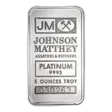
 APMEX
APMEX
1 listing
Filters
| Product | /oz | Premium | Price | |
|---|---|---|---|---|
| $1,900.39 | +13.25% | $9,501.95 | View Deal |

Prices are fetched automatically and may not reflect current merchant prices. Currency conversions and tax treatment are approximate. Rankings are based solely on price. We are not a dealer and accept no responsibility for transactions with listed merchants. Past performance is not indicative of future results. This site does not provide investment advice. Full disclaimer
About the 5 oz Johnson Matthey Platinum Bar
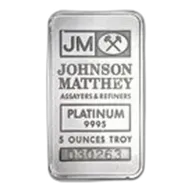
The 5 oz Johnson Matthey Platinum Bar
A 5 oz platinum bar holds five troy ounces (155.52 grams) of one of the scarcest metals in retail bullion. Johnson Matthey ceased retail and investment bullion bar production in 2000 and sold its gold and silver refining businesses to Asahi Holdings in 2015, so JM-branded bars are available only on the secondary market. That heritage is the main draw: Johnson Matthey was appointed Official Assayer and Refiner to the Bank of England in 1852, held LBMA London Good Delivery accreditation for gold from 1961, and from roughly 1971 to 2000 was the largest manufacturer of minted bullion bars in North America. Vintage JM bars are among the most recognised and liquid secondary-market bullion items, trading with minimal dealer friction.
The brand carries particular weight in platinum. George Matthey drove the firm's platinum specialisation in the nineteenth century, and after the 1925 discovery of the Merensky Reef deposits in South Africa, Johnson Matthey secured refining and distribution rights for what became the world's largest platinum mine. Few bullion brands have a deeper connection to the metal.
As a format, 5 oz is an uncommon platinum size. The 1 oz bar is the most commonly traded retail platinum unit, and larger platinum bars occupy a thin secondary market, so a 5 oz JM bar is a substantial, collector-adjacent holding rather than an everyday stacking unit. Buyers get a meaningful block of platinum with a storied hallmark; sellers should expect a narrower pool of buyers than for 1 oz products.
Platinum Bar Tax Treatment by Country
Platinum gets noticeably worse tax treatment than gold in several major markets, and bars lack the legal tender status that shields some coins from capital gains tax.
- UK: 20% VAT on purchase, and Capital Gains Tax applies on sale since bars are not legal tender. This is the least tax-efficient way to hold platinum in the UK.
- US: No federal sales tax; most states exempt bullion, though some tax it or apply purchase thresholds. Long-term gains are taxed at the collectibles rate of up to 28%. IRA eligibility requires platinum of 99.95% purity or higher from accredited sources, so verify the fineness of any secondary-market bar before assuming it qualifies.
- Canada: 0% GST/HST for platinum refined to 99.5% purity or higher in bar form.
- Australia: 0% GST for investment-grade platinum, defined as 99% purity or higher.
- New Zealand: GST-exempt at 99% purity or higher.
- Singapore: 0% GST under the Investment Precious Metals scheme for platinum of 99% purity or higher; no capital gains tax.
- Hong Kong: No sales tax, no import duty, no capital gains tax.
- EU: Full national VAT applies, typically 17-27%; the investment gold exemption does not extend to platinum.
Johnson Matthey: Two Centuries of Refining
Percival Norton Johnson founded the firm in 1817 at 79 Hatton Garden, London, as an assayer and practical mineralogist, and it became the first London assayer to offer buy-backs on assayed gold bars. George Matthey joined as an apprentice in 1838 and became a full partner in 1851, creating Johnson & Matthey. The Bank of England appointment followed in 1852, and the company was incorporated in 1891.
Platinum became the company's signature. Matthey grew platinum throughput from around 15,000 troy ounces a year in 1860 to around 75,000 by the 1880s, won a gold medal for platinum fabrication at the 1867 Paris International Exhibition, and in 1874 manufactured the international kilogram prototype in platinum-iridium for the Bureau International des Poids et Mesures. In 1919 the firm co-founded the London Gold Fixing alongside N.M. Rothschild, and in 1928 it patented the process for extracting and refining platinum group metals from the Rustenburg ores. The Royston plant later produced the world's first automotive catalytic converters in 1974, a platinum application that still dominates demand today.
In North America, Johnson Matthey and Engelhard were the two dominant producers of investment-grade bullion through the 1970s and 1980s, with JM producing poured and minted bars from operations in Toronto, Brampton and Salt Lake City. Retail bar production ended in 2000; the refining businesses passed to Asahi in March 2015, with the LBMA Good Delivery status transferring at completion. Johnson Matthey PLC continues today as a speciality chemicals company, no longer active in bullion, which fixes the supply of JM-branded bars permanently.
Vintage JM Platinum vs Modern Refiner Bars
The live alternatives to a secondary-market Johnson Matthey bar are new bars from the refiners still producing platinum: PAMP Suisse, Valcambi, Heraeus and Argor-Heraeus, all LBMA-accredited. New bars from these refiners typically come sealed in assay cards with serial numbers, which command better resale prices than loose bars and simplify authentication. A vintage JM bar offers heritage and recognition instead; its hallmark is one of the most trusted in bullion, but an older loose bar may face more scrutiny at sale than a carded modern equivalent.
Size is the other decision. Platinum bar premiums fall with weight, from roughly 5-10% over spot for 1 oz minted bars to about 4-8% at 100g and 3-6% at 1 kg, so a 5 oz bar should price more efficiently per ounce than five 1 oz bars. The trade-off is liquidity: the 1 oz size has the best resale market among platinum bars, while larger formats trade thinly and may need specialist dealers. Buy-sell spreads on platinum are wider than on gold in both absolute and percentage terms, and the gap grows with bar size.
One reassurance with platinum at any size: counterfeits are rare. Platinum's density of 21.45 g/cm3 has no cheap convincing substitute, since tungsten would be detectably light and the only denser candidates, iridium and osmium, cost more than platinum itself. Weight and dimension checks therefore catch most fakes, and the metal neither tarnishes nor corrodes in storage.