1 listing
Filters

 APMEX
APMEX
Prices are fetched automatically and may not reflect current merchant prices. Currency conversions and tax treatment are approximate. Rankings are based solely on price. We are not a dealer and accept no responsibility for transactions with listed merchants. Past performance is not indicative of future results. This site does not provide investment advice. Full disclaimer
About the 10 oz Johnson Matthey Platinum Bar
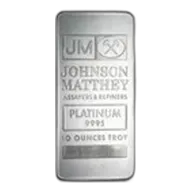
Johnson Matthey 10 oz Platinum Bar
The 10 oz Johnson Matthey Platinum Bar comes from a British firm with a uniquely deep connection to platinum. Johnson Matthey was founded in 1817 and became the world's foremost authority on platinum group metals, refining the first commercially pure platinum and developing most of the industrial applications that drive platinum demand today: catalytic converters, fuel cells, chemical catalysts, and medical devices. Their platinum refining expertise spans over two centuries of continuous operation.
Johnson Matthey exited the retail bullion fabrication business in 2016, selling its gold and silver refining operations to Asahi Refining. Their platinum bars, like Engelhard products, are now exclusively secondary-market items with no new production entering the market. The company itself continues as a FTSE 250 specialty chemicals and sustainable technologies firm focused on catalysts, pharmaceutical ingredients, and hydrogen fuel cell technology, but no longer produces investment bars for retail purchase.
For a 10 oz platinum bar, the Johnson Matthey name carries particular authority. This was not merely a gold refiner that also happened to fabricate platinum bars; it was fundamentally a platinum specialist that also refined gold and silver. Their bars were produced at facilities holding both LBMA (for gold and silver) and LPPM (for platinum and palladium) accreditation to 999.5 fine purity. The dual accreditation reflected genuine expertise in both precious metal families.
In the secondary market, Johnson Matthey platinum bars trade at premiums slightly above generic equivalents and roughly comparable to current-production bars from PAMP Suisse or Valcambi. The JM brand is widely recognised across US, UK, and European dealer networks, ensuring straightforward resale in all major markets.
Johnson Matthey 10 oz Platinum Bar Specifications
| Attribute | Detail |
|---|---|
| Weight | 10 troy ounces (311.035 grams) |
| Purity | 999.5 fine platinum (99.95%) |
| Manufacturer | Johnson Matthey |
| Country of origin | United Kingdom |
| Manufacturer type | Refinery (legacy; retail bullion production ceased 2016) |
| Accreditation | LBMA and LPPM accredited (historical) |
| Serial number | Stamped on bar |
| Hallmark | JM logo with weight, purity, and serial |
Johnson Matthey's dual LBMA and LPPM accreditation was not merely administrative; it reflected two centuries of expertise across both precious metals families (gold/silver via LBMA) and platinum group metals (platinum/palladium via LPPM). The LPPM Good Delivery standard requires minimum 999.5 fineness for platinum bars, which Johnson Matthey consistently met throughout their production history.
Bars carry the distinctive JM hallmark alongside the serial number, weight, and purity stamps. The hallmark style evolved over Johnson Matthey's production history, and experienced dealers can approximately date bars by their hallmark variant. As platinum does not tarnish, oxidise, or degrade under any normal storage condition, these legacy bars remain in their original physical state regardless of age. The metal's hardness (Mohs 3.5) also provides resistance to scratching that softer gold (Mohs 2.5) lacks.
Authentication benefits from platinum's extreme density (21.45 g/cm3). Combined with the JM hallmark verification and serial number records, this makes counterfeit Johnson Matthey platinum bars extremely rare compared to the more commonly counterfeited gold bar market.
Tax Treatment of the 10 oz Johnson Matthey Platinum Bar
As a 999.5 fine platinum bar, the Johnson Matthey product receives standard investment-grade platinum tax treatment across all jurisdictions. The discontinued production status does not alter the tax classification. Being a British-origin product confers no domestic UK tax advantage; platinum bars are fully subject to VAT regardless of where they were manufactured.
Key Jurisdictions
- United Kingdom: 20% VAT on purchase. Subject to CGT on sale at 18-24% rates (GBP 3,000 annual allowance). Being a British-produced bar provides no exemption; platinum bars of all origins are treated identically. The Platinum Britannia coin offers CGT exemption as legal tender; this bar does not.
- United States: State-dependent sales tax (most states exempt). Maximum 28% long-term collectibles CGT rate. IRA eligibility: the 99.95% purity qualifies under Section 408(m), and Johnson Matthey's historical LBMA/LPPM accreditation is generally accepted by IRA custodians for existing bars. Confirm with your specific custodian.
- Canada: GST/HST exempt at 99.5%+ purity. RRSP and TFSA eligible through approved custodians.
- Australia: GST-free at 99%+ purity. Johnson Matthey bars are well-recognised in the Australian market.
- New Zealand: GST-exempt at 99%+ purity. No capital gains tax on disposal.
- Singapore: IPM eligibility at 99%+ purity. Johnson Matthey's LPPM accreditation (though historical) is well-recognised in the Singapore precious metals market, which has a sophisticated dealer network familiar with legacy refiner brands.
- Hong Kong: No purchase tax, import duties, or capital gains tax.
- Germany: Full 19% VAT on purchase. However, gains are entirely tax-free if the bar is held for more than one year (Spekulationsfrist). This makes Germany relatively attractive for long-term platinum holding despite the upfront VAT cost.
- EU (other): Full national VAT rate applies (17-27%).
- South Africa: 15% VAT on platinum bars.