


Prices are fetched automatically and may not reflect current merchant prices. Currency conversions and tax treatment are approximate. Rankings are based solely on price. We are not a dealer and accept no responsibility for transactions with listed merchants. Past performance is not indicative of future results. This site does not provide investment advice. Full disclaimer
About 1/4 oz Silver Rounds
Quarter-Ounce Silver Rounds: A Niche Fractional Format
A 1/4 oz silver round contains 7.7758 grams of silver, struck in coin shape by a private mint with no face value, no legal tender status, and no government backing. Unlike gold, where 1/4 oz is the middle fractional weight produced by every major sovereign mint, 1/4 oz is not a standard silver bullion weight. It appears occasionally as a fractional product from private mints rather than as a core line, and most of the silver round market is built around the dominant 1 oz format.
The case for rounds in general rests on cost: they offer a coin format at near-bar pricing, a practical compromise for buyers who want stackable, countable, standard-weight pieces without paying for legal tender status. Silver rounds are far more popular than gold rounds because silver's much lower unit price, roughly USD 30-40 per ounce against USD 3,000+ for gold, makes the premium saving meaningful for retail stackers. The fractional sizes extend that logic downward for buyers who want pieces smaller than a full ounce, whether for small gifts or for holding silver in the smallest tradeable increments.
The trade-off is availability and recognition. Fractional rounds in 1/2 oz, 1/4 oz, and 1/10 oz sizes are available from some mints only, so the choice of designs and brands is far narrower than at 1 oz. Buyers who do not specifically need a sub-ounce piece will find 1oz silver rounds cheaper per ounce of metal, more widely stocked, and easier to sell on. The quarter-ounce round is a deliberate choice for divisibility, not a default stacking unit.
Where 1/4oz Silver Round Premiums Sit
Silver rounds as a category carry premiums of 5-10% over spot, positioned between bars at 3-8% for common sizes and government coins at 15-25%. That positioning is the core appeal: rounds deliver more ounces per dollar than sovereign coins while keeping the coin-like shape that stacks in standard tubes. Within the round category, well-known brands such as Sunshine and Asahi price slightly above truly generic rounds, and popular design series can carry collector premiums above generic pieces, though that is the exception rather than the rule.
Tax treatment shapes the real cost more than the headline premium in some countries. Silver rounds are taxed like silver bars everywhere; the coin versus non-coin distinction only matters for CGT in the UK, and rounds are not coins. In the UK that means 20% VAT on purchase and no CGT exemption on sale, so rounds are hard to justify against CGT-exempt Britannias or lower-premium bars. In the EU, standard VAT applies with no margin scheme advantage, since rounds are not second-hand coins. By contrast, Canada exempts silver from GST/HST at 99.9% purity or higher in bar, ingot, coin or wafer form, while Australia and New Zealand exempt silver at 99.9% or higher, and Singapore exempts qualifying silver at 99.9% from accredited refiners. Standard .999 fine rounds meet all of those thresholds.
For buyers weighing this format against alternatives, the comparison runs in two directions. Up the scale, the 1 oz round is the dominant standard weight and the benchmark the rest of the category prices against. Sideways, a 1oz silver Britannia or other sovereign coin costs more upfront but recovers more premium at resale.
What Is Available at the Quarter-Ounce Size
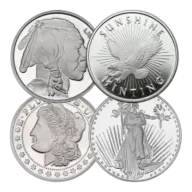
Because 1/4 oz is not a standard silver weight, the product range at this size is thin compared with the 1 oz market. Fractional rounds at 1/2 oz, 1/4 oz, and 1/10 oz are produced by some private mints as extensions of their main lines rather than as flagship products. The major names in silver rounds are Sunshine Minting, SilverTowne, Asahi, Golden State Mint, Highland Mint, Provident Metals with its house brand, and Elemetal, and the classic generic designs are the Buffalo round, based on the US Buffalo nickel and the most widely produced generic silver round, and the Walking Liberty round, based on the Walking Liberty half dollar.
Standard purity across the category is .999 fine silver, with some private mints striking .9999 rounds. Purity matters for tax in several countries: Canada's GST/HST exemption requires 99.9% or higher, while the Australian and New Zealand GST exemptions and Singapore's GST exemption for qualifying silver require 99.9%. A .999 round clears every one of those bars, so the fractional format does not cost anything in tax eligibility.
Rounds are more of a commodity product than branded goods, and for most buyers the design is secondary to the metal content. Private mints do produce creative, themed, and commemorative designs that would never appear on government coinage, and some design series develop secondary market followings, but at the quarter-ounce size the practical advice is simpler: buy from an established mint, confirm the .999 purity, and treat the piece as divisible silver rather than a collectable. Buyers wanting recognised security features will note that Sunshine Minting's MintMark SI, readable with a proprietary decoder lens, is the main anti-counterfeiting technology available on rounds.
Selling and Storing Quarter-Ounce Rounds
Resale ease for rounds depends heavily on brand. Rounds from well-known private mints such as Sunshine, SilverTowne, and Asahi sell without difficulty to any reputable dealer, while generic or obscure-brand rounds may take longer to sell and recover less of their original premium. The round-trip economics favour rounds on metal and coins on premium recovery: a round bought at 8% over spot might sell back at 4-6% over spot, whereas a coin bought at 20% over might sell at 15-18% over. The round buyer gets more metal upfront; the coin buyer recovers more of the premium at exit. Rounds sell at a discount to equivalent coins but at parity with, or a small premium to, generic bars.
Geography matters too. Silver rounds are primarily a North American phenomenon. Their popularity is strongest in the US, where a wide dealer network makes resale straightforward and the tax-neutral environment lets rounds compete purely on premium versus liquidity. In Europe and Asia, sovereign mint coins and bars dominate the retail market and rounds are less familiar to dealers, which adds friction for a niche size like 1/4 oz on top of the format's existing unfamiliarity outside North America.
Storage follows coin conventions. Rounds share the same physical format as coins and are compatible with standard tubes and capsules; tubes typically hold 20 rounds, matching most sovereign mint coin tubes, and for large quantities in tubes or monster boxes rounds trade efficiently with tight spreads. Silver tarnishes, so store rounds in dry conditions, use anti-tarnish strips, and keep them sealed where practical. The same care applies whether the pieces are quarter-ounce fractionals or full-ounce silver rounds.
1/4 oz Silver Rounds: frequently asked questions
-
A 1/4 oz silver round contains 1/4 oz of fine silver. Its intrinsic value is a quarter of the live $67.63 silver spot price; retail prices from dealers include a premium above that melt value. The live silver price moves continuously, so the value changes throughout the trading day.
-
A 1/4 oz silver round weighs 1/4 oz (7.78 grams). One troy ounce of silver equals 31.1 grams, so a quarter-ounce piece is 7.78 g. The troy ounce is the standard measurement for precious metals and is slightly heavier than an avoirdupois ounce (28.35 g) used in everyday weights.
-
Tube counts for 1/4 oz silver rounds vary by issuer and there is no single industry standard for this size. Packaging details differ between brands, so check the specific dealer listing for the count before purchasing, as the packaged quantity affects the per-round price.
-
In the UK, gains above the £3,000 annual allowance are subject to Capital Gains Tax at 18% or 24% depending on your income. In the US, silver is a collectible, with long-term gains taxed at up to 28%. In Canada, 50% of the gain is included in taxable income. Requirements and thresholds vary by country, so keep records of purchase and sale prices.
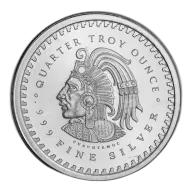
- 1/4 oz Aztec Calendar Silver Round
- 1/4 oz Bull and Bear Silver Round
- 1/4 oz Egyptian Relic Silver Round
- 1/4 oz Golden State Mint Buffalo Silver Round
- 1/4 oz GSM Silver Eagle Silver Round
- 1/4 oz Incuse Indian Silver Round
- 1/4 oz Silver Round
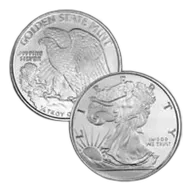
- 1/4 oz Walking Liberty Silver Round
- Pre-Owned 1/4 oz Golden State Mint Buffalo Silver Round
- Pre-Owned 1/4 oz Incuse Indian Silver Round
- Pre-Owned 1/4 oz Walking Liberty Silver Round