5 products · 14 deals





Prices are fetched automatically and may not reflect current merchant prices. Currency conversions and tax treatment are approximate. Rankings are based solely on price. We are not a dealer and accept no responsibility for transactions with listed merchants. Past performance is not indicative of future results. This site does not provide investment advice. Full disclaimer
About 5 oz Silver Rounds
The 5 oz Silver Round in Context
A 5 oz silver round contains 155.517 grams of fine silver, a mid-range weight sitting between the 1 oz pieces that dominate the rounds market and the 10 oz format common in bars. Rounds at this weight are coin-shaped bullion struck by private mints, with no face value, no legal tender status, and no government backing. Within the rounds category, 1 oz is the standard weight; 2 oz and 5 oz rounds exist but are uncommon, so the 5 oz round buyer is choosing a niche product within an already cost-focused form.
The appeal of the 5 oz weight is partly aesthetic and partly practical. The large coin format has visual presence that a small bar lacks, and it offers a step up from 1 oz pieces without the outlay of a 10 oz unit. The trade-off is that the format occupies an in-between position: not as premium-efficient as 10oz silver bars, and not as liquid as 1oz silver coins.
Geography matters here. Silver rounds are primarily a North American phenomenon; in Europe and Asia, sovereign mint coins and bars dominate the retail market, and dealers outside the US and Canada are less familiar with rounds. The 5 oz weight itself is also not a traditional bar size in European or Asian markets, where metric weights such as 100g, 250g, 500g, and 1 kg are more common. UK buyers face a further hurdle: rounds carry 20% VAT on purchase and, lacking legal tender status, are not CGT-exempt on sale, so they offer no tax advantage over bars and compare poorly with CGT-exempt Britannias. In the tax-neutral US market, by contrast, rounds compete purely on premium versus liquidity, which is where they are strongest.
How 5 oz Round Premiums Compare Across the Weight Scale
Silver rounds as a form typically carry premiums of 5-10% over spot. That places them between silver bars, at 3-8% for common sizes, and government coins at 15-25%. Rounds offer a coin format at near-bar premiums: stackable, countable, standard-weight pieces without the cost of legal tender status. In VAT jurisdictions such as the UK and EU, rounds offer no VAT advantage over coins or bars, so the savings are purely in the product markup.
The 5 oz weight sits in a predictable spot on the per-ounce curve. At this weight, silver bars run premiums in the 4-7% range depending on manufacturer: lower per ounce than 1 oz products, but slightly higher per ounce than 10 oz bars. The general rule across the weight scale is that 10 oz bars offer better per-ounce premiums than 5 oz pieces with comparable liquidity, which is why 5 oz is best understood as a middle ground for buyers who find 1 oz too small but 10 oz too much per unit.
Brand affects price within the rounds category. Well-known private mints such as Sunshine and Asahi carry slightly higher premiums than truly generic rounds, and special edition or popular design series can carry collector premiums above generic pieces, though that is the exception rather than the rule. At the 5 oz weight specifically, the coin alternatives behave differently: the 5 oz silver Libertad and the America the Beautiful series carry collector premiums above standard bar premiums, especially for low-mintage years or popular designs. A generic 5 oz round avoids that collector pricing entirely, which is the point of the format.
What Is Available at the 5 oz Weight
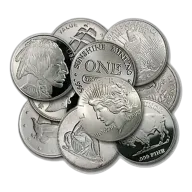
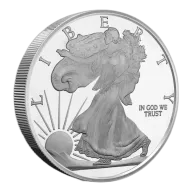
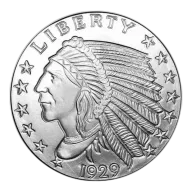
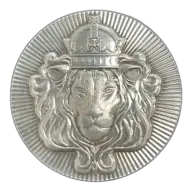
Five-ounce rounds are an uncommon format, so the selection is thinner than at 1 oz, where designs like the Buffalo round, the most widely produced generic silver round, and the Walking Liberty round define the category. The private mints active in 5 oz silver include Scottsdale, Sunshine, and SilverTowne, alongside LBMA-accredited refiners, producing in both cast and minted formats. Among the recognised round brands, Sunshine Minting pieces carry the MintMark SI security feature, the SilverTowne Prospector is a popular generic design from an established US brand, and Asahi, the successor to Johnson Matthey, brings major refiner branding to the rounds market. Silver rounds are more of a commodity product than branded goods; for most buyers the design is secondary to the metal content.
The 5 oz weight is better known through sovereign coins than rounds. The America the Beautiful series (2010-2021) from the US Mint produced the largest silver bullion coins ever struck by the United States, in .999 silver at 76.2mm diameter, and made 5 oz a mainstream weight for American collectors and investors. The series ended in 2021 after 56 designs and is now secondary market only, which can increase collector premiums on certain designs. The Mexican 5 oz Silver Libertad has very low annual mintages compared with other sovereign coins, making it sought-after internationally, and the Perth Mint has struck 5 oz Lunar coins. A buyer comparing 5 oz silver coins against rounds at the same weight is choosing between collector pricing on those coins and the plain bullion pricing of private mint products.
Selling and Storing 5 oz Silver Rounds
Rounds from well-known private mints such as Sunshine, SilverTowne, and Asahi sell without difficulty to any reputable dealer. Generic or obscure-brand rounds may take longer to sell and recover less of their original premium, so sticking to established mints matters if resale liquidity is a priority. The exit economics are characteristic of the form: a round bought at 8% over spot might sell back to a dealer at 4-6% over spot, whereas a coin bought at 20% over spot might sell at 15-18% over spot. The round buyer gets more metal upfront; the coin buyer recovers more of the premium at exit. At resale, rounds generally trade at a discount to equivalent coins but at parity with, or a small premium to, generic bars.
The 5 oz weight adds one liquidity consideration: fewer 5 oz pieces are traded than 1 oz or 10 oz products, so the weight is somewhat less liquid simply through lower volume. There is no difficulty selling to any established dealer, but the buyer pool is smaller than for the standard weights either side of it.
Storage follows the coin pattern rather than the bar pattern. Rounds share the physical format of coins and are compatible with standard tubes and capsules, though large 5 oz pieces take more space per ounce than bars; for comparison, a 5 oz silver bar is roughly half the volume of a 10 oz bar and compact for home safe storage. Standard silver tarnish precautions apply: store in dry conditions, use anti-tarnish strips, and keep pieces sealed where practical. For authentication, rounds lack sovereign mint security features, so verification relies on weight and dimension checks, the magnet slide test (a rare earth magnet should slide slowly down a tilted silver round), sigma testing, and, on Sunshine pieces, the MintMark SI decoder lens feature.
5 oz Silver Rounds: frequently asked questions
-
The intrinsic metal value of a 5oz silver round is 5 times the silver spot price, shown as $67.63 per troy ounce on this page. That figure is the floor; dealer ask prices include a fabrication and distribution premium above it. Use the table above to compare what dealers are currently charging.
-
Standard investment-grade 5oz silver rounds are struck from 999 fine silver (99.9% purity). Some specialist rounds are produced to .9999 fineness (99.99%), though this is less common in the 5oz format. Check the individual product listing to confirm the purity of a specific round before purchasing.
-
Silver rounds are privately minted and carry no face value or legal-tender status. Silver coins are produced by government mints and are recognised as legal tender in their issuing country. Rounds typically trade at a lower premium than government-issued coins of the same weight because they lack that sovereign backing.
-
A 5oz silver round contains 5 oz of silver. Five troy ounces equals 155.52 grams, since one troy ounce is 31.1035 grams. Troy ounces are the standard unit for precious metals and are heavier than the avoirdupois ounce used in everyday measurements.
- 5 oz Allegories Silver Round
- 5 oz American Buffalo Silver Round
- 5 oz Aztec Calendar Silver Round
- 5 oz Bull & Bear Silver Round
- 5 oz Golden State Mint Lunar Silver Round
- 5 oz GSM Silver Eagle Silver Round
- 5 oz Incuse Indian Silver Round
- 5 oz Monarch Precious Metals Zodiac Silver Round
- 5 oz Morgan Silver Round
- 5 oz Scottsdale Cowboy Silver Round
- 5 oz Scottsdale Stacker Silver Round
- 5 oz Second Amendment Silver Round
- 5 oz Signs of the Zodiac Silver Round
- 5 oz Silver Buffalo Silver Round
- 5 oz Silver Round
- 5 oz Sunshine Eagle Silver Round
- 5 oz The Awakening Series Silver Round
- 5 oz US Mint Liberty Silver Round
- 5 oz Walking Liberty Silver Round
- Pre-Owned 5 oz Scotiabank Silver Round
- Pre-Owned 5 oz Scottsdale Stacker Silver Round
- Pre-Owned 5 oz Silver Round