6 products · 20 deals Prices & premiums exclude tax to compare across countries
Filters






Prices are fetched automatically and may not reflect current merchant prices. Currency conversions and tax treatment are approximate. Rankings are based solely on price. We are not a dealer and accept no responsibility for transactions with listed merchants. Past performance is not indicative of future results. This site does not provide investment advice. Full disclaimer
About 1/2 oz Silver Rounds
Half Ounce Silver Rounds: Fractional Silver Without Legal Tender Pricing
The 1/2 oz silver round occupies an unusual corner of the bullion market. Half an ounce is not a standard silver bullion weight; sovereign mints rarely strike silver coins at this size, and where 1/2 oz silver pieces exist from government mints they are usually commemoratives or proofs rather than bullion. Private mints have filled that gap, producing 1/2 oz rounds as part of the fractional line-ups that sit beneath the dominant 1 oz format.
Silver rounds are coin-shaped bullion struck by private mints. They carry no face value, no legal tender status, and no government backing. That absence of official status is exactly what keeps their cost down: buyers pay for the metal and the minting, not for a sovereign mint's brand. The standard purity is .999 fine silver, the same fineness used for most modern bullion coins and the LBMA Good Delivery minimum for silver bars.
Who buys at this weight? Stackers who want smaller, more divisible units than the 1 oz silver round provides. A half ounce piece lets a holder sell or trade silver in finer increments, and the low unit price of silver makes small-denomination pieces affordable in a way that fractional gold never is. The trade-off is cost efficiency: per-unit manufacturing, handling, and distribution costs are roughly fixed regardless of how much silver a piece contains, so the smaller the piece, the larger those costs loom as a percentage of the total. Buyers maximising ounces per dollar are better served by 1 oz rounds or silver bars; buyers who value divisibility accept the premium penalty.
Rounds are primarily a North American phenomenon. In Europe and Asia, sovereign mint coins and bars dominate the retail market, and dealers outside the US and Canada are less familiar with private-mint rounds. That geography matters at this weight in particular, since the 1/2 oz round depends entirely on private mints for supply and on the North American dealer network for resale.
How 1/2 oz Round Premiums Compare Across the Silver Weight Scale
Silver premiums are driven by a simple mechanic: minting, packaging, and handling cost roughly the same per piece whether the piece holds half an ounce or ten ounces. Because silver trades at a low per-ounce price, those fixed costs make up a much larger share of the final price than they do for gold, and the share grows as the piece shrinks. A 1/2 oz round therefore carries a higher percentage premium than the same design in the 1 oz format, and substantially more than larger bars.
The published reference points run as follows for silver in normal market conditions: branded 100 oz bars at roughly 2-4% over spot, 10 oz bars at 4-8%, 1 oz generic bars at 5-10%, generic rounds at 8-15%, sovereign coins from roughly 12% (Philharmonic, Kangaroo) up to 20-30% (American Silver Eagle), and fractional silver coins at 25-40% or more. Fractional rounds sit below fractional sovereign coins in that hierarchy, because rounds as a category price between bars and government coins, but the fixed-cost effect still pushes them well above what the same mints charge per ounce on their 1 oz versions.
The practical comparison for a buyer weighing this size runs in both directions. Moving up to the 1 oz silver round buys noticeably more silver per dollar, since the 1 oz format is where private-mint production volume concentrates and competition is fiercest. Moving down to the 1/4 oz silver round or 1/10 oz round pushes the percentage premium higher again for the same fixed-cost reason.
One factor that does not change with weight: in VAT jurisdictions such as the UK and EU, rounds offer no tax advantage over coins or bars. UK buyers pay 20% VAT on silver rounds at any weight, and the pieces carry no CGT exemption on sale. The premium saving versus a sovereign coin is purely in the product markup, and it has to be weighed against that tax position.
Half Ounce Rounds from Golden State Mint, SilverTowne, and Other Private Mints
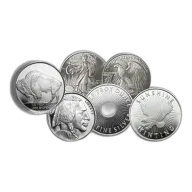
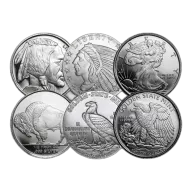
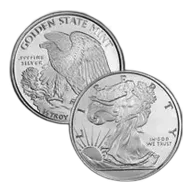
Production at this weight comes from the established US private mints, and the designs mirror the classic themes that dominate the 1 oz round market. The most widely produced generic design is the Buffalo round, based on the US Buffalo nickel; at 1/2 oz it appears from several mints, with the 1/2 oz Golden State Mint Buffalo, SilverTowne, and Highland Mint versions all trading on comparison sites. The Walking Liberty round, based on the classic Walking Liberty half dollar design, is also struck at this size.
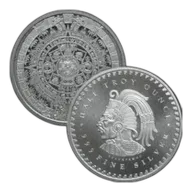
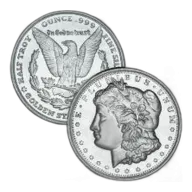
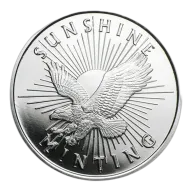
Golden State Mint's Incuse Indian design series, a popular line in the rounds market, extends to the 1/2 oz format as well, as does the Aztec Calendar round, which is among the most widely stocked half ounce designs. Sunshine Minting produces an Eagle design at this weight; Sunshine rounds are notable for the MintMark SI security feature, a mark visible with a proprietary decoder lens and the main anti-counterfeiting technology available on private-mint rounds. Themed pieces such as Morgan-design and Bull and Bear rounds round out the field.
A buyer choosing between these should weigh brand against price. Well-known mints such as Sunshine, SilverTowne, and Asahi carry slightly higher premiums than truly generic rounds, but their pieces sell without difficulty to any reputable dealer. Obscure-brand rounds cost less upfront and may take longer to sell on. Design rarely matters for value: rounds are bought for metal content, and only the occasional limited-edition series develops a modest secondary-market following.
All of these are .999 fine silver. There is no purity spread to navigate at this weight, and no face value or legal tender distinction between any of them. The comparison comes down to premium, mint reputation, and which design the buyer prefers to stack.
Selling, Storing, and Handling 1/2 oz Silver Rounds
Resale is where the half ounce round's niche status shows. Rounds from well-known private mints sell without difficulty to any reputable dealer, but rounds generally sell at a discount to equivalent sovereign coins and at parity with, or a small premium to, generic bars. The published pattern for the category: a round bought at 8% over spot might sell back at 4-6% over spot, while a coin bought at 20% over might recover 15-18%. The round buyer gets more metal upfront; the coin buyer recovers more premium at exit. At fractional weights the acquisition premium is higher to begin with, so the gap between purchase price and dealer buyback widens accordingly.
Geography matters too. Rounds are strongest in the US market, where the wide dealer network makes resale straightforward. Dealers in Europe and Asia are less familiar with private-mint rounds, and a 1/2 oz piece from a smaller US mint is a harder sell outside North America than a recognised sovereign coin.
Storage follows standard silver practice. Rounds share the coin format, so they are compatible with standard tubes and capsules, and they tarnish exactly as other silver does: hydrogen sulphide in the air forms a dark silver sulphide layer on the surface. The tarnish is cosmetic, does not reduce metal content, and dealers buy tarnished bullion at the same price, but prevention is straightforward: airtight capsules or tubes, anti-tarnish strips, silica gel, and no rubber bands or PVC holders, both of which release sulphur compounds.
For buyers holding meaningful value at this weight, the bulk consideration that applies to all silver applies double here: silver already occupies far more space per dollar than gold, and splitting it into half ounce units adds packaging volume on top. Stackers building a large position usually keep fractional rounds as a small divisible layer alongside 10 oz silver bars or 1 oz pieces rather than as the core holding.
1/2 oz Silver Rounds: frequently asked questions
-
A half-oz silver round contains 1/2 oz of .999 fine silver. Its melt value is half the live $67.63 silver spot price; dealer prices add a premium above that figure to cover minting and handling costs. Compare listings on this page to find the lowest current premium available from tracked dealers.
-
Tube counts for half-oz silver rounds vary by manufacturer. There is no single universal convention for this size, so packaging details differ between brands. Check the dealer listing for the specific count before purchasing, particularly if buying in bulk, as the quantity affects the per-round price.
-
Silver rounds are privately minted and carry no face value or legal-tender status. Government coins, such as Silver Eagles or Britannias, are struck by sovereign mints and are legal currency in their issuing country. Both can be .999 fine silver, but government coins typically carry a higher premium over spot, partly because of their official backing and secondary-market recognition.
-
Yes. Fine silver tarnishes when exposed to sulphur compounds in the air, though it tarnishes more slowly than sterling silver (which contains copper). Storing rounds in airtight plastic capsules or anti-tarnish packaging significantly slows this process. Tarnish does not affect the silver content or melt value of the round.
- 1/2 oz Aztec Calendar Silver Round
- 1/2 oz Bull and Bear Silver Round
- 1/2 oz Egyptian Relic Silver Round
- 1/2 oz Golden State Mint Buffalo Silver Round
- 1/2 oz GSM Silver Eagle Silver Round
- 1/2 oz Incuse Indian Silver Round
- 1/2 oz Morgan Silver Round
- 1/2 oz Silver Round
- 1/2 oz Sunshine Eagle Silver Round
- 1/2 oz Walking Liberty Silver Round
- Pre-Owned 1/2 oz Silver Round