


Prices are fetched automatically and may not reflect current merchant prices. Currency conversions and tax treatment are approximate. Rankings are based solely on price. We are not a dealer and accept no responsibility for transactions with listed merchants. Past performance is not indicative of future results. This site does not provide investment advice. Full disclaimer
About 1/10 oz Silver Rounds
1/10 oz Silver Rounds: The Smallest Standard Round
A 1/10 troy ounce round contains 3.1103 grams of silver, making it one of the smallest pieces in the fractional range. Silver rounds are coin-shaped bullion struck by private mints rather than government facilities. They carry no face value, no legal tender status, and no government backing, which is precisely why they undercut sovereign coins on price. The standard purity is .999 fine silver, with some private mints striking .9999 rounds.
The dominant weight in the silver round market is 1 oz. Fractional rounds at 1/2 oz, 1/4 oz, and 1/10 oz are available from some mints, but they are a niche within a niche. Buyers who choose the 1/10 oz size are typically after maximum divisibility: small pieces that can be sold, traded, or gifted individually without breaking into a larger holding. The low unit price also makes this size an accessible entry point, since silver itself trades at roughly USD 30-40 per ounce against USD 3,000+ for gold.
The economic tradeoff is the same one that applies across all fractional bullion. The manufacturing costs of a round, including die work, quality control, and packaging, are nearly the same regardless of size, so on a tenth-ounce piece those fixed costs are spread over one-tenth the metal. Accumulating silver through 1/10 oz rounds therefore costs meaningfully more per ounce than buying 1oz silver rounds outright. The small size serves a purpose, but bulk accumulation is not it.
How 1/10 oz Round Premiums Compare
Silver rounds as a category typically carry premiums of 5-10% over spot. That positions them between bars, where common sizes run 3-8%, and government coins at 15-25%. Rounds offer a coin format at near-bar premiums, which is their core appeal: stackable, countable, standard-weight pieces without the cost of legal tender status.
Those category figures are dominated by the 1 oz size. Moving down the weight scale works against the buyer, because the fixed costs of striking a round, the die work, quality control, and packaging, are spread over progressively less metal. A 1/10 oz piece carries one-tenth the silver of a standard round but close to the same production cost, so the percentage premium climbs as weight falls. The tenth-ounce class carries the highest relative premiums of any standard bullion weight for exactly this reason. Within the round market, well-known brands such as Sunshine and Asahi also carry slightly higher premiums than truly generic rounds.
Tax treatment shapes the picture by country. Silver rounds are taxed the same as silver bars everywhere; the coin versus non-coin distinction only matters for CGT in the UK, and rounds are not coins. UK buyers pay 20% VAT on new silver rounds with no CGT exemption on sale. In the EU, standard VAT rates apply with no margin scheme advantage, since rounds are not second-hand coins. Canada exempts precious metals refined to 99.9%+ purity from GST/HST, Australia applies 0% GST to investment-grade silver at 99.9%+ purity, and New Zealand exempts silver at 99.9%+ purity. In the US, most states exempt bullion from sales tax, and capital gains are taxed at the 28% collectibles rate.
Who Makes Fractional Silver Rounds
Fractional silver rounds, including the 1/10 oz size, are produced by only some private mints, and the selection is far thinner than at 1 oz. The major names in the round market are Sunshine Minting, SilverTowne, Asahi, Golden State Mint, Highland Mint, and Elemetal, with Provident Metals striking a house brand. Not every one of these offers a tenth-ounce piece, so availability at this weight comes and goes with mint production runs and dealer stock.
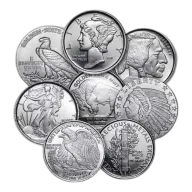
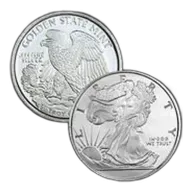
The designs that dominate the round market are classics borrowed from American coinage. The Buffalo round, based on the US Buffalo nickel, is the most widely produced generic silver round, and the Walking Liberty round draws on the Walking Liberty half dollar. Sunshine Minting rounds carry the MintMark SI security feature, readable with a proprietary decoder lens, which is the main anti-counterfeiting technology available on rounds. The SilverTowne Prospector and Golden State Mint's Incuse Indian are established design series with their own followings.
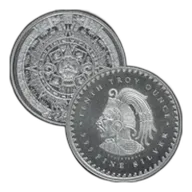
For most buyers, though, rounds are a commodity product rather than branded goods: the design is secondary to the metal content. Private mints do produce creative and themed designs that would never appear on government coins, and some series develop modest secondary market followings, but collector value is the exception. Buyers wanting a deeper product range at this weight will find that fractional silver coins from sovereign mints offer more choice, at higher premiums.
Selling and Storing Tenth-Ounce Rounds
The 1/10 oz weight class is described as having variable liquidity, with the widest bid-ask spreads of any fractional size. Sellers should expect to recover less of the premium they paid than they would on larger pieces. Layered on top of that is the usual round-market rule: pieces from well-known private mints such as Sunshine, SilverTowne, and Asahi sell without difficulty to any reputable dealer, but generic or obscure-brand rounds may take longer to move and recover less of their original premium. Brand matters; if resale liquidity is a priority, stick to established mints.
Rounds in general sell at a discount to equivalent government coins but at parity with, or a small premium to, generic bars. The offsetting factor for small pieces is the buyer pool: the low price point of a tenth-ounce round attracts more potential purchasers, which puts a floor under demand even where spreads are wide. Note also that silver rounds are primarily a North American product. Dealers in Europe and Asia, where sovereign coins and bars dominate the retail market, are less familiar with them, which matters if you may need to sell outside the US or Canada.
Storage follows coin conventions. Rounds share the coin format, so they are compatible with standard tubes and capsules, and tubes typically hold 20 rounds, matching most sovereign mint coin tubes. The usual silver tarnish considerations apply: dry conditions, anti-tarnish strips, and sealed packaging where practical. Tiny pieces like these are easy to misplace, so capsules or tubes are worth using from day one.
1/10 oz Silver Rounds: frequently asked questions
-
A 1/10 oz silver round contains 1/10 oz of fine silver, giving it a melt value derived from the live $67.63 silver spot price. Dealer prices sit above that melt value because rounds carry a manufacturing and handling premium, so the retail cost is spot times 0.1 plus whatever premium the seller charges.
-
A 1/10 oz silver round weighs 3.11 grams. That figure comes from the troy ounce, the standard unit for precious metals: one troy ounce equals 31.1 grams, so a tenth of that is 3.11 g. The weight is the same across all makers because it reflects the silver content standard, not the design.
-
Yes. Smaller denominations consistently carry higher premiums over spot because the fixed costs of minting, packaging, and shipping are spread over much less silver. A 1/10 oz round can carry a substantially larger percentage premium than a 1 oz or 10 oz round from the same maker, making it less efficient purely as a way to accumulate silver by weight.
-
There is no universal size standard for 1/10 oz silver rounds, so diameter varies by manufacturer. Dimensions can differ noticeably between designs and issuers. If precise dimensions matter for storage or display, check the specifications on the individual dealer listing.
-
Tube counts vary by issuer and design. Packaging details differ between brands, so check the dealer listing to confirm the exact count before ordering in bulk. Where available, larger bulk formats such as monster boxes are listed separately by dealers.