1 product · 1 deal
Filters
| Product | /oz | Premium | Price | |
|---|---|---|---|---|
| $80.06 | +18.39% | $800.65 | View Deal |

Prices are fetched automatically and may not reflect current merchant prices. Currency conversions and tax treatment are approximate. Rankings are based solely on price. We are not a dealer and accept no responsibility for transactions with listed merchants. Past performance is not indicative of future results. This site does not provide investment advice. Full disclaimer
About 10 oz Silver Rounds
10oz Silver Rounds: A Bulk Format in a Private-Mint Product
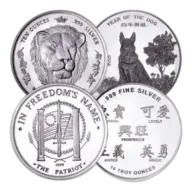
Silver rounds are coin-shaped bullion struck by private mints. They carry no face value, no legal tender status, and no government backing, which is precisely why they cost less than sovereign coins of the same weight. The 10 troy ounce format, equal to 311.035 grams, brings the bulk-buying logic of mid-size bars into that round format. A single 10oz piece replaces ten individual ounces, and because manufacturing, shipping, and handling costs are relatively fixed per unit, spreading them across ten ounces instead of one cuts the percentage premium.
The round market is heavily weighted toward smaller pieces. One ounce is the dominant weight, and even 2oz and 5oz rounds are uncommon, so a 10oz round is a niche product compared with the 10oz silver bar, which is the dominant silver bar weight for retail investors in the US and Canada. Buyers at this weight are typically stackers accumulating metal in volume rather than collectors: dealer budget guidelines suggest that anyone buying 300 to 500 dollars or more of silver regularly is better served by 10oz pieces than by repeated 1oz purchases.
The trade-off against alternatives runs in two directions. Against 1oz silver rounds, a 10oz piece gives up divisibility: you cannot sell three ounces of it. Against kilo and larger bars, the 10oz format keeps each piece at a manageable value while the additional per-ounce premium saving of moving up to a kilo bar is small, often under one percent. Most silver rounds are .999 fine, with some private mints producing .9999, so the format clears the purity thresholds that matter for tax in Canada (99.9%), Australia, New Zealand, and Singapore (99.9%).
One regional caveat applies. Silver rounds are primarily a North American phenomenon; in Europe and Asia, sovereign coins and bars dominate the retail market and dealers are less familiar with rounds. UK buyers face a further disadvantage: rounds attract 20% VAT on purchase and, lacking legal tender status, carry capital gains tax liability on sale, so they offer no tax advantage over bars and none of the CGT exemption that silver Britannias enjoy.
How 10oz Round Premiums Sit on the Weight and Format Scale
Two pricing forces meet at this weight: the format discount of rounds and the bulk discount of 10 ounces. Silver rounds as a category typically carry premiums of 5 to 10% over spot, positioned between bars at 3 to 8% for common sizes and government coins at 15 to 25%. That is the round proposition in general: a coin format at near-bar premiums, without paying for legal tender status.
Weight then compounds the saving. The reference point at this weight is the 10oz bar, which under normal conditions trades at 3 to 6% over spot versus 5 to 15% for 1oz bars, a saving of roughly 1 to 1.50 dollars per ounce. At 30 dollars spot, a 10oz piece at a 4% premium costs about 312 dollars, while the same ten ounces bought as 1oz pieces at a 10% premium costs about 330 dollars, roughly 18 dollars saved per 10 ounces. Moving further up the scale buys little more: the per-ounce premium gap between 10oz and kilo bars is often under one percent, which is why the 10oz weight is widely considered the best balance of premium savings and liquidity.
Brand affects the figure within the round category. Well-known private mints such as Sunshine and Asahi carry slightly higher premiums than truly generic rounds, and special edition or popular design series can carry collector premiums above generic pricing, though that is the exception rather than the rule. In VAT jurisdictions such as the UK and EU, none of this premium arithmetic escapes the tax: rounds receive no VAT advantage over coins or bars, so the saving is confined to the product markup itself. In tax-neutral markets like the US, where most states exempt bullion from sales tax, the comparison comes down purely to premium versus liquidity, which is where the 10oz round makes its strongest case.
What Is Actually Available at 10 Ounces
Honesty about the catalogue helps here: the silver round market is built around the 1oz piece, and the classic designs that define the category are produced overwhelmingly at that weight. The Buffalo round, based on the US Buffalo nickel and the most widely produced generic silver round, and the Walking Liberty round, based on the classic half dollar design, are struck by various private mints. Branded alternatives include the Sunshine Minting round with its MintMark SI security feature, the SilverTowne Prospector, the Asahi round carrying the branding of the refiner that succeeded Johnson Matthey, and the Golden State Mint Incuse Indian. At 10 ounces the selection from these mints is far thinner, so buyers should expect a smaller field of mostly generic designs rather than a fixed roster of flagship products.
That makes the practical comparison set at this weight the neighbouring formats. The 10oz silver bar is the deepest market at this weight, with bars from the Royal Canadian Mint, Royal Mint, PAMP Suisse, Valcambi, Asahi, Sunshine Minting, Scottsdale Mint, Nadir, and Geiger Edelmetalle, in both cast and minted finishes. On the coin side, 10oz pieces exist but are uncommon: the 10oz Royal Mint Valiant, 10oz Queen's Beasts silver issues, and Perth Mint Lunar 10oz coins all carry collector premiums above bullion pricing.
For most buyers the decision resolves on purpose. A 10oz round suits someone who wants bulk silver in a coin-like shape from a private mint; a 10oz bar from a recognised refiner offers the widest choice and tightest pricing at the weight; and the 10oz sovereign coins are collector products rather than stacking vehicles. Silver rounds are more of a commodity product than branded goods, and the design is secondary to the metal content for most buyers, which holds even more strongly at bulk weights.
Selling, Storing, and Handling 10oz Rounds
Resale at this weight follows the brand rules that govern rounds generally. Pieces from well-known private mints such as Sunshine, SilverTowne, and Asahi sell without difficulty to any reputable dealer, while generic or obscure-brand rounds may take longer to sell and recover less of their original premium. The exit arithmetic favours rounds on metal content: a round bought at 8% over spot might sell back at 4 to 6% over spot, whereas a sovereign coin bought at 20% over might sell at 15 to 18%. The round buyer gets more metal upfront; the coin buyer recovers more of the premium at exit. Rounds generally sell at a discount to equivalent coins but at parity with, or a small premium to, generic bars.
The weight adds its own constraint. Like any 10oz piece, a 10oz round is less flexible than 1oz pieces for partial liquidation: selling it is an all-or-nothing transaction. Buyers who expect to sell in small increments should keep some 1oz silver rounds alongside bulk pieces. Geography matters too. Rounds are a North American product, and dealers outside the US and Canada handle them less routinely, so liquidity is strongest where the dealer network is densest.
On storage, the tube and box conventions of the round market are built around the standard 1oz piece: tubes typically hold 20 rounds, matching most sovereign mint coin tubes, and rounds in tubes stack and store identically to coins. A 10oz piece sits outside those conventions and stores more like a small bar. The usual silver tarnish rules apply regardless of weight: tarnish comes from sulphur compounds in the air, is purely cosmetic, and does not reduce metal content or what a dealer pays, but airtight capsules, anti-tarnish strips, dry conditions, and avoiding PVC holders keep pieces presentable. Bulk pieces concentrate silver's storage burden efficiently; ten ounces in one piece occupies less space than ten packaged singles.
10 oz Silver Rounds: frequently asked questions
-
A 10 oz silver round contains 10 oz of .999 fine silver, so its melt value is ten times the live $67.63 silver spot price. There are 5 listings across 3 dealers tracked on this page, making it straightforward to compare premiums. Dealer prices sit above melt value to cover minting and handling costs.
-
A 10 oz silver round weighs 10 oz (311 grams, or 10 troy ounces). Diameter varies by maker and design, so there is no single standard for this size. If dimensions matter for storage in a specific capsule or display box, check the maker's specifications for the particular product.
-
Silver rounds are privately minted and carry no face value or legal-tender status. Silver coins are struck by government or sovereign mints and are official currency in their issuing country. Both can be .999 fine silver, but coins typically command a higher premium over spot because of their official status and wider secondary-market recognition. At 10 oz, the premium gap between rounds and equivalent government pieces can be meaningful.
-
Tax treatment varies by country. In the UK, silver carries 20% VAT. In Canada, investment-grade silver is exempt at 0%. In Australia, silver bullion is also exempt at 0%. In the US there is no federal sales tax, but individual states set their own exemptions, so whether tax applies depends on where you buy.
-
Generally yes. Silver rounds are privately minted with no sovereign backing, and at the 10 oz size the premium over $67.63 spot is typically lower than for government coins of comparable weight. The 3 dealers tracked here sell 5 listings, so the premiums tab shows the current spread and lets you compare directly against other silver products.