13 products · 57 deals
Filters
| Product | /oz | Premium | Price | |
|---|---|---|---|---|

2 deals
|
$4,362.33 | +0.39% |
$140,252.15
£105,104
|
Compare |
| $4,418.31 | +1.42% |
$142,051.70
S$181,599
|
View Deal | |

4 deals
|
$4,418.31 | +1.42% |
$142,051.70
S$181,599
|
Compare |

2 deals
|
$4,423.61 | +1.54% |
$142,222.07
S$181,817
|
Compare |

10 deals
|
$4,416.86 | +1.65% |
$142,005.30
£106,417
|
Compare |

23 deals
|
$4,420.16 | +1.72% |
$142,111.32
£106,497
|
Compare |

3 deals
|
$4,442.04 | +2.23% |
$142,814.76
£107,024
|
Compare |

3 deals
|
$4,451.32 | +2.44% |
$143,113.29
£107,248
|
Compare |

2 deals
|
$4,477.18 | +2.93% |
$143,944.59
A$202,170
|
Compare |

3 deals
|
$4,496.36 | +3.46% |
$144,561.17
€126,144
|
Compare |
| $4,453.20 | +3.57% |
$143,173.61
NZ$250,711
|
View Deal | |
| $4,582.04 | +5.45% |
$147,315.88
£110,397
|
View Deal | |
| $4,655.25 | +5.61% | $149,666.33 | Compare |


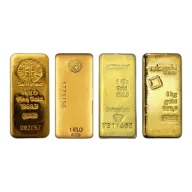
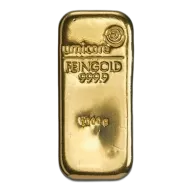
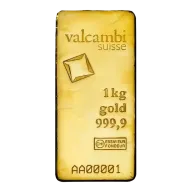
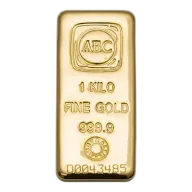
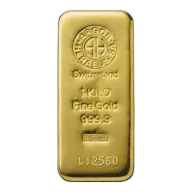

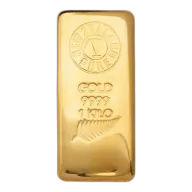

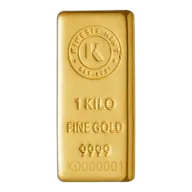

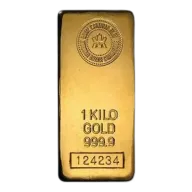
Prices are fetched automatically and may not reflect current merchant prices. Currency conversions and tax treatment are approximate. Rankings are based solely on price. We are not a dealer and accept no responsibility for transactions with listed merchants. Past performance is not indicative of future results. This site does not provide investment advice. Full disclaimer
About 1 Kilo Gold Bars
Who Buys 1 Kilo Gold Bars
A kilogram of gold, 32.1507 troy ounces, is the standard metric bullion weight and the largest gold bar commonly traded at retail. At current prices a kilo bar represents roughly $100,000 or more in a single piece, which puts it firmly in high-net-worth and institutional territory. Buyers at this weight are optimising for the lowest possible cost per gram, not flexibility: the kilo bar is the most premium-efficient retail gold format available.
The format has a strong regional identity. In Asia, the kilo is the standard retail gold bar weight, traded on the Shanghai Gold Exchange and through the Singapore Bullion Market Association, and kilobars dominate modern trading in Singapore, Hong Kong, and mainland China. European refiners (PAMP, Valcambi, Heraeus, Umicore) are the primary producers, and metric weights are the norm across European markets. In the UK and North America the kilo competes with troy-ounce denominations and is more of a specialist choice, though it is widely available and common among institutional gold buyers.
All major LBMA-accredited refiners produce kilo bars, and the format is recognised globally; bars from accredited refiners are interchangeable across borders. Tax treatment is favourable in most markets: investment gold at this purity is VAT-exempt in the UK and across the EU, GST-free in Australia and Singapore, GST/HST-exempt in Canada, and untaxed in Hong Kong. The UK caveat is that bars carry CGT liability on disposal, unlike legal tender coins, which matters at this transaction size. For buyers who do not need divisibility, nothing in the retail gold market beats the kilo bar on cost per gram, but the trade-offs around liquidation are real and covered under the liquidity tab.
Kilo Gold Bar Premiums vs Smaller Formats
Gold kilo bars carry premiums of roughly 1-2% over spot, the lowest percentage premium of any retail gold product. The gold bar premium curve falls steadily with size: 1g bars can run 15-25% over spot, 100g bars 2-4%, and the kilo sits at the bottom of the curve. Against coins the gap is wider still, since 1 oz sovereign coins price several points above large bars. A $100,000 allocation in bars rather than coins can save $2,000-4,000 in premiums, and the kilo bar is where that saving is fully realised.
The marginal gains shrink near the top of the scale. The premium difference between a 10 oz gold bar at 1-3% and a kilo bar at 1-2% is small per ounce, though it accumulates on large purchases. The practical question for most large buyers is not whether the kilo is cheapest (it is) but whether the all-or-nothing liquidation profile suits them.
Cast bars price below minted bars of the same weight thanks to their simpler production, and both formats exist at the kilo size. Brand adds a modest layer: PAMP Suisse bars command a small premium over generic refiner bars on recognition, while output from less famous LBMA refiners is the cheapest route to the metal.
Because investment gold is VAT-exempt in the UK, EU, and most other major markets, the quoted premium is close to the genuine all-in acquisition cost. The lifecycle cost depends on exit taxes: in the UK, gains on bars above the £3,000 annual allowance are taxable at 18-24%, while in Germany bars held over 12 months sell tax-free.
Major 1 Kilo Gold Bars
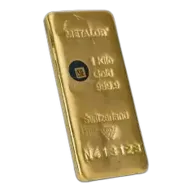
Kilo gold bars are a refiner product, and the producer list reads as a roll call of LBMA accreditation: PAMP Suisse, Valcambi, Argor-Heraeus, Heraeus, Metalor, the Perth Mint, and the Royal Canadian Mint all strike kilo bars to Good Delivery purity standards. Dealer listings reflect this spread, with Metalor, Valcambi, Perth Mint, PAMP Suisse, Heraeus, Umicore, and Argor-Heraeus kilo bars among the most widely stocked, alongside unbranded generic kilo bars that price at the bottom of the market.
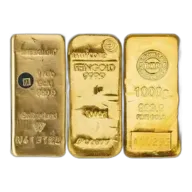
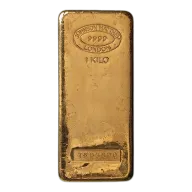
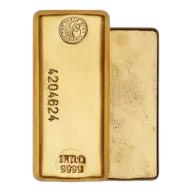
Format is a genuine choice at this weight. Cast kilo bars are poured into moulds, with a rougher, chunkier finish and lower prices; minted bars are cut and polished, serialised, and presented more like a finished product. Both routes deliver the same fine gold content, so the decision is between saving on the cast premium and the cleaner presentation and packaging of the minted bar.
Two clarifications on standards. First, LBMA Good Delivery in the trading sense refers to the roughly 400 oz (12.5 kg) bars that settle the institutional market; kilo bars are not Good Delivery bars, but those from LBMA-accredited refiners are produced to the same purity standards and enjoy near-universal acceptance. Second, government-mint kilo bars (Perth Mint, Royal Canadian Mint) and Swiss refiner bars are functionally equivalent on purity; the choice between them is brand preference and price on the day. Coins barely exist at this weight in gold, so unlike at smaller sizes there is no meaningful coin alternative to weigh up.
Selling and Storing a Kilo of Gold
Liquidity for LBMA-accredited kilo bars is excellent. Dealers maintain ready markets, and gold kilo bars from recognised refiners are interchangeable globally: a PAMP or Valcambi kilo bar can be sold to any dealer in any country. For a six-figure single object, that is as liquid as physical property gets.
The structural drawback is indivisibility. A kilo bar is an all-or-nothing sale; there is no way to liquidate a quarter of it to raise cash. Holders who anticipate needing partial liquidity are better served splitting the same budget across 100g bars or 1 oz units, accepting a slightly higher blended premium as the cost of flexibility. This single factor, more than price, is what separates kilo buyers from everyone else.
Provenance protects value at this size. Bars in sealed assay packaging from accredited refiners resell cleanly, while a bar without papers may need re-assaying at the seller's expense. The counterfeiting concern specific to large gold bars, tungsten-core substitution, is most relevant for secondary market purchases of big bars; tungsten's density (19.25 g/cm3) is close enough to gold's (19.32 g/cm3) to defeat weight checks, and ultrasonic testing is the reliable non-destructive screen. Buying from authorised dealers in sealed packaging sidesteps the issue.
Storage is trivially easy in physical terms. Gold's density (19.32 g/cm3) makes a kilo bar roughly the size of a small smartphone, and multiple bars stack neatly, giving the best value-to-space ratio in retail bullion. Gold is soft, though, so bars should not be stored loose against each other; surface scratches reduce resale appeal on minted bars.
1 Kilo Gold Bars: frequently asked questions
-
A 1 kilo gold bar contains 32.15 troy ounces of fine gold, so its price tracks the gold spot rate of $4,408.10 per troy ounce plus a dealer premium. BullionFerret currently lists products from 38 dealers at this weight; use the table to compare premiums. The spot-based melt value alone makes a kilo bar a significant purchase.
-
For investment purposes, the key credential is LBMA good-delivery accreditation. Bars from accredited refiners are accepted by dealers worldwide and carry no liquidity penalty. At the 1 kg level, premiums across mainstream brands are broadly similar; resale acceptance and LBMA accreditation matter more than brand prestige.
-
Check the hallmark and serial number against the refiner's published database, and verify the bar weighs exactly 1,000 grams with the correct dimensions for that maker. A valid assay certificate from the refiner should accompany the bar. For a definitive test, an XRF (X-ray fluorescence) assay from an accredited assayer confirms purity without damaging the bar.
-
Yes, gains from selling gold are generally taxable. In the UK, gains above the £3,000 annual exemption must be reported to HMRC; the rate is 18% for basic-rate taxpayers and 24% for higher-rate. In Canada, 50% of any gain is included in taxable income. In the US, profits on gold are taxed at up to 28% for long-term holdings. Check the rules in your country for any local variations.
- 1 Kilo ABC Cast Bar Gold Bar
- 1 Kilo Ainslie Gold Bar
- 1 Kilo Argor-Heraeus Gold Bar
- 1 Kilo Austrian Mint Gold Bar
- 1 Kilo Credit Suisse Gold Bar
- 1 Kilo Degussa Gold Bar
- 1 Kilo Engelhard Bar Gold Bar
- 1 Kilo Fortuna Gold Bar
- 1 Kilo Go Gold Bar
- 1 Kilo Gold Bar
- 1 Kilo Gold Bullion Australia Gold Bar
- 1 Kilo Heraeus Gold Bar
- 1 Kilo Johnson Matthey Gold Bar
- 1 Kilo Kinesis Gold Bar
- 1 Kilo Metalor Gold Bar
- 1 Kilo PAMP Suisse Gold Bar
- 1 Kilo Perth Mint Gold Bar
- 1 Kilo Republic Metals Corporation Gold Bar
- 1 Kilo Royal Canadian Mint Gold Bar
- 1 Kilo Sunshine Minting Gold Bar
- 1 Kilo The Royal Mint Gold Bar
- 1 Kilo UBS Gold Bar
- 1 Kilo Umicore Gold Bar
- 1 Kilo Valcambi Gold Bar
- Pre-Owned 1 Kilo Al Etihad Gold Bar
- Pre-Owned 1 Kilo Austrian Mint Gold Bar
- Pre-Owned 1 Kilo Baird Cast Bar Gold Bar
- Pre-Owned 1 Kilo Credit Suisse Gold Bar
- Pre-Owned 1 Kilo Gold Bar
- Pre-Owned 1 Kilo Metalor Gold Bar
- Pre-Owned 1 Kilo Minted Bars Gold Bar
- Pre-Owned 1 Kilo The Royal Mint Gold Bar
- Pre-Owned 1 Kilo Umicore Gold Bar