95 products · 463 deals Prices & premiums exclude tax to compare across countries
Filters
| Product | /oz | Premium | Price (ex. tax) | |
|---|---|---|---|---|

7 deals
|
$1,745.77 |
-0.60%
+7% inc.VAT
|
$17,457.71
€16,334 inc.VAT
|
Compare |

3 deals
|
$1,800.18 | +2.87% | $1,800.18 | Compare |

7 deals
|
$1,802.88 | +3.02% | $1,159.25 | Compare |
| $1,810.18 | +3.44% | $1,810.18 | Compare | |

2 deals
|
$1,814.52 |
+3.47%
+24% inc.VAT
|
$58,338.10
£51,938 inc.VAT
|
Compare |

2 deals
|
$1,826.60 |
+4.01%
+12% inc.VAT
|
$1,826.60
€1,709 inc.VAT
|
Compare |
| $1,821.56 | +4.09% | $1,171.26 | View Deal | |

5 deals
|
$1,829.33 | +4.53% | $588.13 | Compare |
| $1,841.56 | +5.23% | $1,841.56 | View Deal | |

2 deals
|
$1,847.99 |
+5.37%
+26% inc.VAT
|
$29,707.12
£26,448 inc.VAT
|
Compare |
| $1,849.24 |
+5.44%
+27% inc.VAT
|
$9,244.36
£8,230 inc.VAT
|
View Deal | |

2 deals
|
$1,846.18 | +5.50% | $1,846.18 | Compare |
| $1,851.57 | +5.80% | $925.78 | Compare | |

4 deals
|
$1,861.68 | +5.97% |
$59,854.47
£44,407
|
Compare |

2 deals
|
$1,855.76 | +6.04% | $5,966.39 | Compare |
| $1,860.50 | +6.07% | $18,605.00 | View Deal | |
| $1,873.27 | +6.86% | $1,873.27 | Compare | |
| $1,879.90 | +7.18% | $1,879.90 | View Deal | |
| $1,880.58 | +7.46% | $18,805.83 | View Deal | |
| $1,885.10 | +7.47% | $1,885.10 | View Deal | |

31 deals
|
$1,884.99 |
+7.48%
+29% inc.VAT
|
$1,884.99
£1,678 inc.VAT
|
Compare |
| $1,885.03 |
+7.49%
+29% inc.VAT
|
$188.50
£168 inc.VAT
|
Compare | |
| $1,889.26 | +7.71% | $1,889.26 | View Deal | |
| $1,891.34 | +7.83% | $1,891.34 | Compare | |

6 deals
|
$1,893.80 |
+7.99%
+30% inc.VAT
|
$6,088.69
£5,421 inc.VAT
|
Compare |
| $1,894.13 | +8.24% |
$60,897.52
S$78,040
|
View Deal | |

21 deals
|
$1,902.60 |
+8.49%
+30% inc.VAT
|
$1,902.60
£1,694 inc.VAT
|
Compare |
| $1,902.60 |
+8.49%
+30% inc.VAT
|
$1,902.60
£1,694 inc.VAT
|
Compare | |

9 deals
|
$1,902.60 |
+8.49%
+30% inc.VAT
|
$1,902.60
£1,694 inc.VAT
|
Compare |

14 deals
|
$1,902.60 |
+8.49%
+30% inc.VAT
|
$1,902.60
£1,694 inc.VAT
|
Compare |






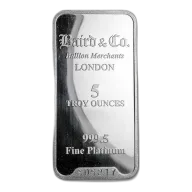
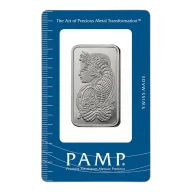

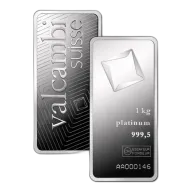












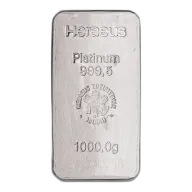



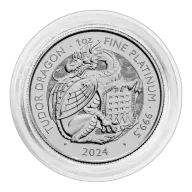
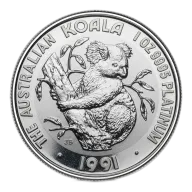
Prices are fetched automatically and may not reflect current merchant prices. Currency conversions and tax treatment are approximate. Rankings are based solely on price. We are not a dealer and accept no responsibility for transactions with listed merchants. Past performance is not indicative of future results. This site does not provide investment advice. Full disclaimer
About Platinum Bullion
Platinum Bullion: The Industrial Metal With Investment Credentials
Platinum is the rarest of the three principal bullion metals. Annual mine production runs around 180 tonnes, compared to roughly 3,670 tonnes for gold and 25,500 tonnes for silver. That scarcity, combined with concentrated supply chains and strong industrial demand, gives platinum a fundamentally different investment profile from its more established peers.
The platinum bullion market is small. Investment demand (bars, coins, and ETFs combined) accounted for just 8.5% of total platinum demand in 2024, at 702,000 ounces. The rest went to automotive catalytic converters (38%), industrial applications (30%), and jewellery (24%). This means platinum's price is driven primarily by industrial cycles and automotive production, not by monetary policy or safe-haven flows as with gold.
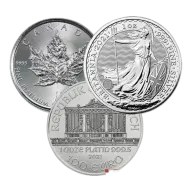
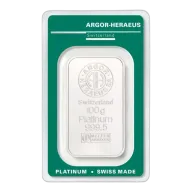
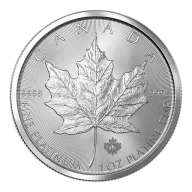
For buyers, platinum bullion comes in coins, bars, and, rarely, rounds. The product range is narrower than gold or silver. Five sovereign mints currently produce platinum coins: the US Mint (American Platinum Eagle), Royal Canadian Mint (Platinum Maple Leaf), Royal Mint (Platinum Britannia), Perth Mint (Platinum Kangaroo), and Austrian Mint (Platinum Philharmonic). All five are struck at 999.5 fine, and all are relatively recent additions, with the oldest (the Maple Leaf) dating only to 1988.
Platinum's density of 21.45 g/cm3 makes it the densest of the bullion metals, even denser than gold. A 1 oz platinum coin is slightly smaller in diameter than a 1 oz gold coin of the same purity. Like gold, platinum does not tarnish or corrode under normal conditions, requiring no special storage precautions beyond basic security. Its greater hardness (3.5 on the Mohs scale versus gold's 2.5) makes platinum coins and bars more resistant to scratches and handling wear.
The most discussed feature of the platinum market is its current discount to gold. Platinum traded above gold for most of the period from the mid-1990s through 2014. Since 2015, it has consistently traded below gold, currently at roughly 30-40% of the gold price. That reversal was driven by the 2015 Dieselgate emissions scandal (which weakened expectations for diesel catalytic converter demand), sluggish jewellery demand, and gold's strengthening investment bid from central banks. The platinum market has been in structural supply deficit for three consecutive years, with above-ground stocks declining to roughly 4 months of demand coverage by end-2025. That combination of supply constraints and a historically unusual discount to gold is the core of the investment case.
Platinum Tax Treatment Across Major Markets
Platinum receives less favourable tax treatment than gold in most jurisdictions. The key difference: gold benefits from specific investment exemptions in the UK and EU that do not extend to platinum. In countries with purity-based exemptions (Canada, Australia, New Zealand, Singapore), platinum typically qualifies, often at a lower purity threshold than gold or silver.
United Kingdom
Platinum bullion is subject to 20% VAT on purchase, whether bars or coins. There is no investment platinum exemption equivalent to the investment gold exemption. This VAT is a substantial cost: a buyer paying GBP 800 for a 1 oz platinum coin pays GBP 160 in unrecoverable VAT on top of the dealer premium. On disposal, platinum bars are subject to Capital Gains Tax at 18-24%, with the GBP 3,000 annual allowance. The Platinum Britannia is CGT-exempt as UK legal tender, the same exemption applied to gold and silver Britannias. For UK buyers, the Britannia is the only platinum product that avoids CGT. VAT-free vault storage (metal kept outside free circulation) is the primary workaround for the purchase tax.
United States
Most states exempt investment-grade precious metals, including platinum, from sales tax. The same 42+ state exemptions that apply to gold apply to platinum. On disposal, platinum is classified as a collectible, taxed at a maximum long-term rate of 28%. Platinum meeting the 99.95% purity standard is IRA-eligible. All four major sovereign platinum coins (Eagle, Maple Leaf, Britannia, Kangaroo) qualify.
Canada
Platinum at 99.5%+ purity is GST/HST exempt in all forms (bars, coins, wafers). Capital gains are taxable at the standard 50% inclusion rate (66.67% above CAD 250,000 from June 2024). The Platinum Maple Leaf qualifies for RRSP and TFSA accounts.
Australia
Platinum at 99%+ purity is GST-free when in investment form. This is a lower purity threshold than for gold (99.5%) or silver (99.9%), and all standard platinum bullion products exceed it. Capital gains are subject to CGT with the standard 50% discount for holdings over 12 months.
New Zealand
Platinum at 99%+ purity is GST-exempt. No capital gains tax applies. Combined with the low purity threshold, this makes New Zealand one of the more favourable jurisdictions for platinum.
Singapore
Platinum qualifies as an Investment Precious Metal (IPM) at 99%+ purity, exempt from the 9% GST. Bars must be from an LPPM-accredited refiner. No capital gains tax. Singapore's exemption threshold for platinum is lower than for gold (99.5%) and silver (99.9%).
Hong Kong
No sales tax, no VAT, no import duty, and no capital gains tax on platinum bullion. Fully tax-neutral, same as for gold and silver.
South Africa
Platinum bullion is subject to 15% VAT. South Africa does not produce a platinum Krugerrand for regular bullion sales, so there is no legal tender coin exemption comparable to the gold Krugerrand's VAT-free status. Capital gains are taxed at a 40% inclusion rate for individuals.
European Union
Standard VAT applies to platinum across all EU member states, at rates from 17% (Luxembourg) to 27% (Hungary). There is no investment platinum exemption equivalent to the EU Investment Gold Directive. Capital gains treatment varies. Germany exempts gains on assets held longer than one year. No margin scheme is widely applied to platinum in the EU.
Platinum Purity Standards
The platinum bullion market is notably uniform in purity compared to gold, which has both 22-carat and 24-carat products in wide circulation.
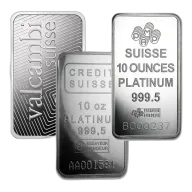
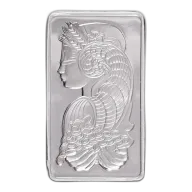
999.5 fine (99.95%) is the universal standard for investment platinum. All five major sovereign mint coins, the American Eagle, Canadian Maple Leaf, Britannia, Kangaroo, and Philharmonic, are struck at this purity. Bars from LPPM-accredited refiners (PAMP Suisse, Valcambi, Heraeus, Argor-Heraeus, Johnson Matthey, Tanaka) are also 999.5. This is the minimum for LPPM (London Platinum and Palladium Market) Good Delivery bars, the institutional standard.
There is no equivalent to gold's 22-carat/24-carat split in the platinum market. Achieving purities above 999.5 is extremely difficult with platinum due to its refining characteristics, so "four nines fine" (999.9) platinum products are essentially nonexistent in the bullion market. Buyers do not need to navigate purity choices the way gold buyers do; virtually every platinum bullion product on the market is 999.5.
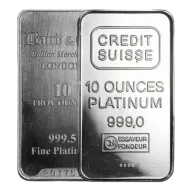
999 fine (99.9%) appears on some bars and is above the tax exemption thresholds for most countries. It falls slightly below the LPPM Good Delivery minimum but meets the purchase tax exemption requirements in Australia, New Zealand, and Singapore (all 99%+) as well as Canada (99%+).
950 fine (95%) is jewellery-grade platinum, used in rings and other manufactured goods. It is not investment grade and does not qualify for tax exemptions in any jurisdiction.
Tax exemption purity thresholds for platinum are generally set lower than for gold or silver. Australia, New Zealand, and Singapore all require 99% (versus 99.5% for gold in those countries and 99.9% for silver in Australia and NZ). Canada requires 99%. The UK has no platinum-specific purity exemption because 20% VAT applies to all platinum regardless. Because all standard investment platinum is 999.5, the purity threshold is a non-issue for buyers of major products. It only becomes relevant for unusual or secondary-market items of uncertain provenance.
Platinum Supply, Demand, and the Structural Deficit
The platinum market has three characteristics that set it apart from gold and silver: extreme geographic concentration of supply, dominant industrial demand, and a persistent structural deficit.
Supply Concentration
Annual mine production was approximately 5,766,000 ounces (179 tonnes) in 2024. South Africa alone produced 71.7% of this total (4,132,000 ounces), with Russia contributing 11.7% (677,000 oz) and Zimbabwe 8.7% (500,000 oz). More than 90% of the world's platinum comes from three countries, two of which carry significant geopolitical and operational risks: South Africa faces persistent power grid instability ("load-shedding") that disrupts mining operations, and Russia faces ongoing international sanctions. No other major bullion metal has this degree of supply concentration. Gold production is spread across dozens of countries on every continent.
Recycling contributed an additional 1,486,000 ounces in 2024, primarily from scrapped automotive catalytic converters. Total supply was 7,293,000 ounces.
Demand Profile
Total demand in 2024 was approximately 8,288,000 ounces, split across four categories:
- Automotive catalytic converters: 3,130,000 oz (38%) used in diesel and increasingly hybrid vehicle emissions systems. Platinum is also being substituted for more expensive palladium in gasoline catalytic converters, a structural tailwind for demand.
- Industrial: 2,462,000 oz (30%) covering glass manufacturing (670,000 oz), chemical processing (609,000 oz), medical devices (308,000 oz), petroleum refining (158,000 oz), and electronics (94,000 oz). Hydrogen fuel cell demand was 44,000 oz, up 92% year-on-year from a small base.
- Jewellery: 1,993,000 oz (24%) with forecast growth of 2% in 2025 to a 6-year high.
- Investment (bars, coins, ETFs): 702,000 oz (8.5%) a small fraction of total demand. For comparison, gold's bar and coin investment alone was 1,374 tonnes in 2025.
The Structural Deficit
The platinum market was in deficit by 995,000 ounces in 2024, the third consecutive year of shortfall. The 2025 forecast projects an 848,000 oz deficit. Cumulative above-ground stocks have declined to an estimated 3,383,000 ounces at year-end 2024, down 23% year-on-year, with a further decline to roughly 2,535,000 ounces projected by end-2025. That represents approximately 4 months of demand coverage. Neither gold nor silver faces this level of inventory drawdown. The declining stock picture is one of the fundamental factors differentiating platinum's investment case from the other bullion metals.
Storing Platinum: Compact, Durable, and Low-Maintenance
Platinum shares gold's practical storage advantages: high density, chemical stability, and minimal space requirements per unit of value. At 21.45 g/cm3, platinum is the densest of the three bullion metals, even denser than gold (19.3 g/cm3). A 1 oz platinum coin or bar is marginally smaller than a 1 oz gold piece at the same purity. Storage requirements per dollar of value are comparable to gold, given that the two metals have traded at similar price ranges historically (and platinum's lower current price means slightly more volume per dollar, though still far more compact than silver).
Platinum does not tarnish or corrode under normal storage conditions. Like gold, it is highly resistant to oxidation and atmospheric degradation. It can develop a very thin surface film when exposed to sulphur, chlorine, or hydrogen sulphide compounds, but this is rare under typical home or vault storage conditions and does not affect value. No desiccants, anti-tarnish strips, or airtight sealing is necessary for platinum storage, unlike silver.
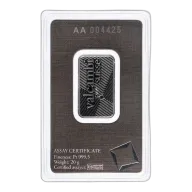
Platinum is harder than gold (3.5 versus 2.5 on the Mohs scale), making platinum coins and bars more resistant to scratches and handling damage. Standard coin capsules and tubes are suitable for storage. Fewer tube sizes are manufactured specifically for platinum coins compared to gold or silver, so buyers should check compatibility. Minted bars in assay cards store flat and stack efficiently.
Platinum's high density also provides a natural defence against counterfeiting. At 21.45 g/cm3, no common inexpensive metal comes close enough in density to substitute convincingly. Tungsten (19.25 g/cm3), the primary counterfeiting concern for gold, is detectably lighter than platinum. The only metals denser than platinum (osmium and iridium) are rarer and more expensive. This makes weight-and-dimension verification a particularly effective authentication method for platinum.
Vault storage costs for platinum are typically calculated on insured value, the same basis as gold. At comparable prices per ounce, the cost per dollar of stored platinum is effectively the same as for gold. For home storage, platinum's compactness makes even a modest safe adequate for significant holdings. The key practical advantage over silver is scale: $50,000 in platinum at current prices weighs roughly 1.5 kg and fits in a single hand, while the same value in silver weighs over 50 kg.
Platinum bullion: frequently asked questions
-
The platinum spot price is the live benchmark for one troy ounce of unallocated platinum, traded on the global interbank market. It currently stands at $1,750.00 per troy ounce. Physical coins and bars are priced at a premium above this to cover fabrication, dealer margin, and delivery costs.
-
Platinum traded at a premium to gold for much of the twentieth century, reflecting its rarity and strong industrial demand. That relationship has since reversed, and platinum has traded at a discount to gold in recent years. The two metals now serve quite different market roles: gold is primarily a monetary and investment metal, while platinum's price is heavily influenced by industrial consumption, particularly catalytic converters.
-
Bars generally carry lower premiums per ounce, especially at larger sizes, making them the more cost-efficient option for straightforward storage. Coins such as the Platinum Maple Leaf or Platinum Britannia have legal-tender status in their issuing countries and can be more liquid in smaller quantities. The tax treatment of platinum coins varies by country, so check the rules that apply to you before buying.
-
Platinum's largest use is in catalytic converters for petrol and some diesel vehicles, which account for a substantial share of annual demand. It is also used in fuel cell technology, jewellery, laboratory equipment, and electronics. Because industrial demand dominates, platinum's price is sensitive to automotive production trends and the pace of the shift toward electric vehicles, making it more volatile than gold in response to economic cycles.
-
Platinum is significantly rarer than gold by annual mine output. Global platinum production is a small fraction of gold production, and the vast majority of the world's supply comes from a very limited number of countries, making the supply chain more geographically concentrated than gold. This concentration adds a geopolitical dimension to platinum's price that does not apply to most other metals.
- American Eagle
- American Palladium Eagle
- American Platinum Eagle
- American Prospector
- Armillary
- Australian Platypus
- Australian Wildlife
- Baird Gold Bar
- Big 5
- Big Five
- Britannia
- CombiBar
- Coronation
- Credit Suisse Liberty
- Fortuna
- Geiger Edelmetalle Geiger Original
- Isle of Man Noble
- Kookaburra
- Liberty
- Maple Leaf
- Multigram
- Myths and Legends
- Noble
- PAMP Liberty
- PAMP Lunar
- Panda
- Perth Kangaroo
- Perth Koala
- Perth Lunar
- Philharmonic
- Phoenix
- Platypus
- Queen's Beasts
- Robin Hood
- Royal Arms
- SA Mint Krugerrand
- Somalia Elephant
- Tudor Beasts
- Wonders of Australia